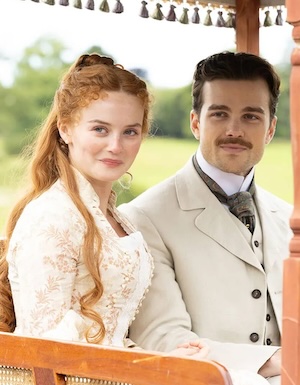
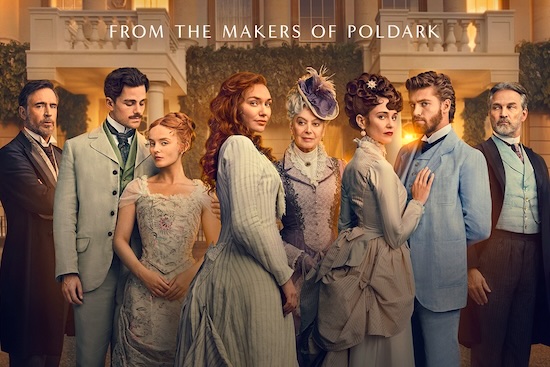
Premiering on MASTERPIECE in March of 2026, the British period series “The Forsytes” chronicles the lives of four generations of an upper-class family of stockbrokers, against the backdrop of a rapidly evolving late-Victorian world.

To help keep this site running: Willow and Thatch may receive a commission when you click on any of the links on our site and make a purchase after doing so.
Willow and Thatch talked with Writer and Executive Producer Debbie Horsfield about her reimagining of John Galsworthy’s novels — her “love letter” to his celebrated Forsyte Saga; that’s below. Watch the trailer, a preview, and read about the cast after the Q&A.
But first, let’s fill you in on the plot and a bit of a who’s who in the new period drama from “Poldark” writer Debbie Horsfield.
Free trials of PBS MASTERPIECE Prime Video Channel are available here.
“The Forsytes” (Season 1) Premieres Sundays, March 22 – April 26, 2026, 9:00 – 10:00 p.m. ET on MASTERPIECE on PBS
What is “The Forsytes” About?
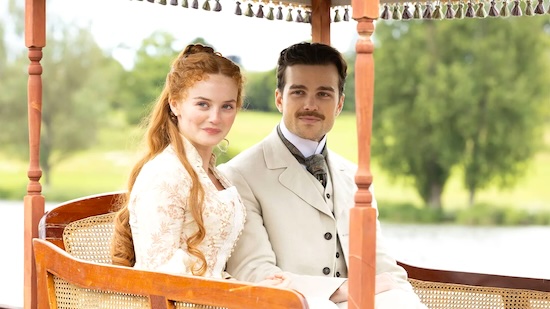
Sticklers for tradition and status, the older Forsytes prize duty and reputation, whilst the younger members rail against the rigidity of family expectations. The question of who will succeed in the family firm, Forsyte & Co., looms large, with rival brothers Jolyon Snr and James battling for their respective sons, Jolyon and Soames, to succeed as chairman. But as each berate their offspring for being torn between duty and love, both harbor a scandalous secret of their own which threatens to undermine them.
Artistic and at odds with the world of business, Jolyon’s life is thrown into disarray when he encounters former lover Louisa, a self-made woman who – until now – has meticulously avoided the Forsytes at all costs. Matters are further complicated when Jolyon discovers he has twins, the result of their passionate affair prior to his marriage to high society queen Frances.
Torn between wife and lover, Jolyon must decide whether to prioritize duty or heart. Frances, having worked tirelessly to become the wife of a chairman, must fight to retain her supremacy, whilst contending with renegade daughter, June, who defies her mother by falling in love with a penniless architect, Philip.
Meanwhile, ambitious Soames’ well-ordered life is overturned when he falls for the free-spirited dancer Irene. He is determined to win her heart and a whirlwind courtship ensues. Expecting her to fit into her expected role in the Forsyte family, he soon discovers that Irene has dreams of her own, and her natural exuberance and creative yearnings will not be so easily subdued.
Ultimately, every member of the Forsyte family faces the eternal dilemma – to be ruled by the head or the heart.
Q&A with Writer and Executive Producer Debbie Horsfield
Willow and Thatch: Do all of the events in Season 1 of “The Forsytes” take place as a prequel to the books? And what is the balance between reimagining the story and following a more direct adaptation?
Debbie Horsfield: This is not what we would call an adaptation. What we’ve done, I’ve looked up the things that really fascinated me about the books, and those were things like the family saga, the rivalry between the generations, the damage that each generation inflicts on the generation that comes below. Those are the things that really interested me, so I picked out those storylines from the books, and basically played around with those. And I did use some of the hints we got in the books of what may have happened before the actual events of the books, and I’ve filled in some of those details.
I’ve also taken some characters, as an example, the character of Francis who is not even mentioned in the book except in a family tree; she doesn’t exist in the books at all. But I was interested in what kind of a woman Jolyon’s first wife would be, so I’ve invented that character. So in a way it’s partly a prequel but also it is a world of its own. And that is how it continues into the second series.
WAT: Before you start writing, you plan extensively and have a clear sense of what will transpire in each episode — but once you start writing, the characters take on a life of their own, and you let them do unexpected things. How did you decide where to start the story, and at what point do you decide how many episodes will work best?
DH: I do a huge amount of research and preparation and have detailed episode plans before I start writing. I always knew I wanted the end point to be the moment where Irene asks Soames to fulfil his promise to release her from their marriage and he denies ever having made that promise in the first place. So it was a question of working backwards from that, and of deciding how to manage and serve a large ensemble of characters and a host of complex storylines over the course of six episodes.
Even when a narrative is inspired by an existing piece of fiction, as a writer one has to eventually take on the characters as one’s own in order to get inside their heads, to try to understand their motives, and eventually to let them have a life of their own, during which, yes, sometimes they do unexpected things. It’s a key reason for not calling “The Forsytes” an adaptation. We’re very clear that it’s a reimagining, inspired by Galsworthy’s characters and narrative. In the end, it’s all fiction, even if (hopefully!) it feels as if the characters are real.
WAT: You’ve called Irene “mysterious and shadowy in the novels.” What were you hoping to do with her character for “The Forsytes”?
DH: I always found Irene to be quite impenetrable in the novels. She is frequently described in terms of her beauty and charisma and her effect on men, but I never got a real sense of who she was or what made her tick! I always found it curious that her physical aversion to Soames dated to well before their marriage, which made me wonder why she ever agreed to marry him.
Surely it couldn’t simply be because she was poor and he was rich? Their long and drawn-out courtship, her constant refusal to marry him, seemed to beg the question “what was she expecting from her marriage?” I wanted to explore her character in more depth, tell the story from her point of view as well as his, and pose the question of whether there could ever have been some hope for their union.
WAT: Can you talk about your philosophy around being historically accurate when you write period dramas and share what motivates you to be as historically accurate as possible even when you are penning a fictionalized series?
DH: We have several brilliant historical advisors on “The Forsytes,” and our aim is to work with them, (and our brilliant design, costume, hair and makeup teams) to create an authentic, believable world. Our historical advisors have worked on multiple Victorian-era period dramas and their advice is always the same: to be as historically accurate and authentic as possible, whilst cautioning that sometimes a slavish adherence to detail can get in the way of story.
For instance, public displays of affection, by either men or women, was absolutely not done, but when the narrative calls for a spontaneous expression of emotion of passion, story trumps etiquette and romance is allowed to win! But details like creating historically accurate decor, table settings, costumes, or hairstyles, these are details which all departments are fanatical about getting right.
WAT: Is it correct to say that you’ve steered clear of portraying any of the characters in “The Forsytes” as villains — including Soames?
DH: In the whole of my career, I’ve made a point of never seeing a character as an out and out “villain”. Though some characters can be seen as the “baddy”, for me it’s always been important to get inside their head to understand why they behave and think as they do, what might be the external forces which shaped their destiny, and to ask whether there is any hope for change or even redemption.
I find Soames a particularly interesting character because he is so obviously a man of his time. So I’ve tried to create a hinterland and a context – of family and societal role models, pressures, and expectations — which might account for his attitudes, his decisions and his behaviour. And I’ve tried to show that no person’s actions can be viewed in isolation, but are instead the product of nature, nurture (or lack of!) and societal context.
Thank you to Debbie for answering our questions and to MASTERPIECE for making this interview possible. Watch the trailer, a preview and read about the cast below.
“The Forsytes” (2025) sweeping and stellar cast features Francesca Annis (Flesh and Blood) as formidable Forsyte matriarch Ann, with Stephen Moyer (True Blood) as eldest son Jolyon Senior, head of the family stockbroking firm Forsyte & Co. Danny Griffin (Fate: The Winx Saga) plays his bohemian son Jo, Tuppence Middleton (Downton Abbey: A New Era) is Jo’s queen of high society wife, Frances, and Eleanor Tomlinson (Poldark) plays Louisa Byrne, a Soho dressmaker and Jo’s first love.
Jack Davenport (The Morning Show) plays Ann’s ambitious younger son James, with Joshua Orpin (Titans) as James’ shrewd and sometimes ruthless son Soames. Millie Gibson (Doctor Who) plays ballet dancer and Soames’ love interest, Irene. Tom Durant Pritchard (Miss Scarlet) plays the comically indolent, social climbing son-in-law, Monty Dartie. Justine Moore (Call the Midwife) plays the spirited daughter June Forsyte.
Jamie Flatters (Avatar: The Way of Water) is architect Philip Bosinney, Josette Simon (Anatomy of a Scandal) is the influential heiress Mrs. Ellen Parker Barrington, and Owen Igiehon (Disclaimer) plays lawyer Isaac Cole.
“The Forsytes” (Season 1) consists of six episodes, all penned by acclaimed “Poldark” screenwriter Debbie Horsfield, and premieres Sunday, March 22, 2026 at 9/8c on MASTERPIECE on PBS.
“The Forsytes” has already been greenlit for a second season and filming of Season 2 began in 2025 in Bristol in the UK. Joining the series for the second season are Richard Rankin (Outlander), Sarah Alexander (Pennyworth) and Nia Ashi (Bob Marley: One Love). In March, 2026, “The Forsytes” (Season 3) was announced, with plans to begin production in May. In Season 3, the family heads to the glamorous French Riviera, but they soon discover that even a luxury villa can’t hide their secrets.
Watch a preview of Season 1 below.
If you enjoyed this post, see our review of “The Forsyte Saga” (2002).