
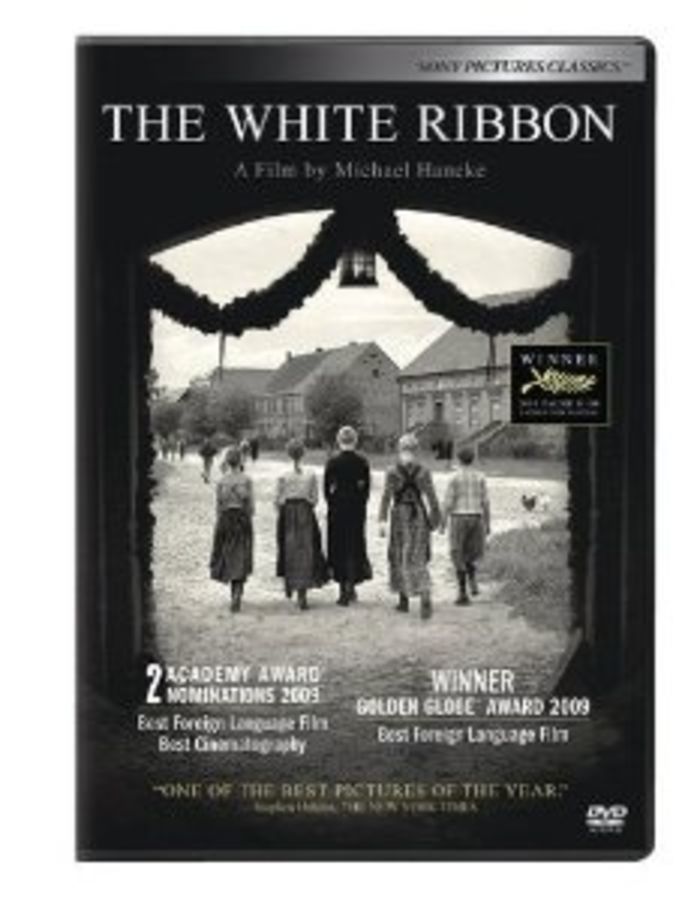
Using their social status and harsh punishments, a baron (Ulrich Tukur), a doctor (Rainer Bock) and a pastor (Burghart Klaussner) rule over a small German village. One day, the doctor falls off his horse after it trips over a wire strung between two trees. More pranks follow, seemingly without reason, all directed at the village’s upper class and growing increasingly more brutal with time. There are no suspects, but a local schoolteacher (Christian Friedel) has his suspicions.
Set in the end of the Edwardian era and at the dawn of WWI.
The only comfort offered by “The White Ribbon,” a chronicle of small-town German life on the eve of World War I, is that the social order it depicts has vanished from the earth. Haneke uses the sharp elegance of Christian Berger’s monochrome cinematography (achieved by shooting in color, then draining it away), the grammatical precision of old-fashioned speech and the pageantry of period drama to lull and also to inflame the audience’s expectations. The effect is something like a ghost story, the horror of which is at once elusive and pervasive. – NYT
Like a Twilight Zone episode directed by Antonioni, The White Ribbon weaves an unsettling and enigmatic spell. Michael Haneke’s film is set just before World War I in a village in northern Germany, where a series of strange occurrences take place over several months. These occurrences are sinister and cruel and often involve the children of the village–not merely as victims (although child abuse seems to be a far-from-isolated event) but also as perpetrators. At least that’s the way it appears. Nothing is completely spelled out in Haneke’s scheme, which hints and insinuates and thoroughly gets under the viewer’s skin over the course of 144 edgy minutes. We might notice the children are of an age that will make them mature participants in the horror of Germany in the 1930s and ’40s, but even this is left as an unemphasized point. Since Haneke is an expert at denying explicit conclusions for his projects, we shouldn’t be surprised that he withholds the answers to the questions he poses, or that the film is even more powerful because of this withholding. Adding to the effect is Christian Berger’s Oscar-nominated black-and-white cinematography, which has a ghostly quality appropriate to the topic. In the end, all the strange happenings of the village are absorbed into the town’s rhythm of life–which might be the most disturbing conclusion of all. –Robert Horton
In German, with English subtitles.
Set in 1914. “The White Ribbon” won the Palme d’Or in Cannes.
Starring Ulrich Tukur, Susanne Lothar, Christian Friedel, Burghart Klaussner, Leonie Benesch, Josef Bierbichler , Rainer Bock, Ernst Jacobi, Ursina Lardi, Fion Mutert, Branko Samarovski, Leonard Proxauf.
Rated R