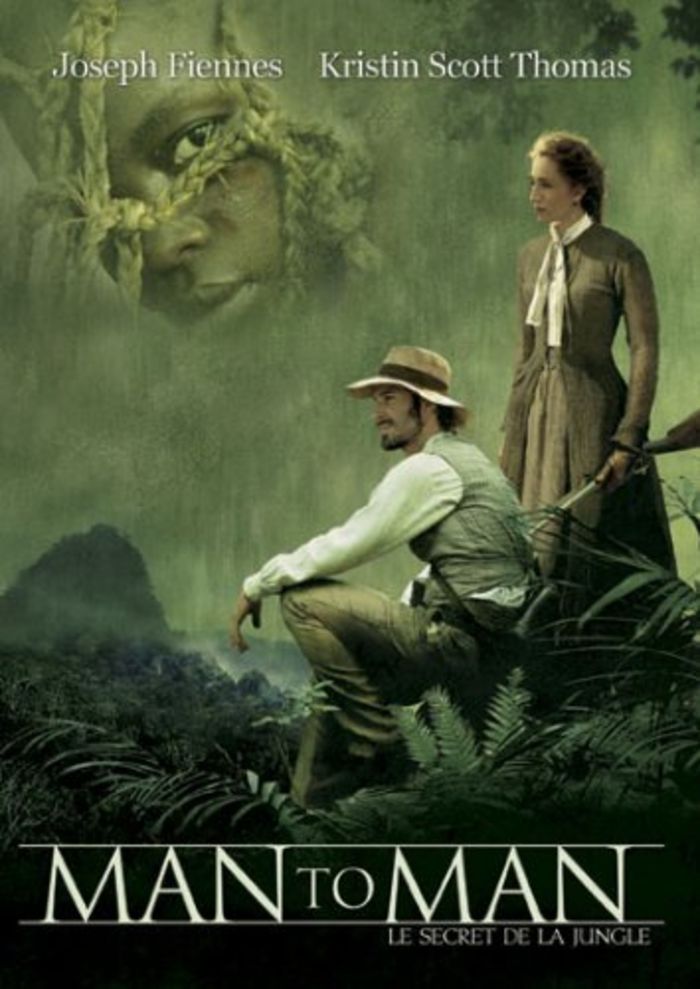
The year is 1870. Dr. Jamie Dodd is elated: he has finally succeeded in capturing not one, but two pygmies. He brings them to Scotland with the help of Elena Van den Ende, an adventurous woman who sells wild animals to the zoos of Europe. His two anthropologist friends, Alexander and Fraser, and himself are certain they have discovered the missing link, which will make them famous. They start examining the pygmy couple from every angle and Jamie gradually discovers that Toko and Likola are just as sensitive and intelligent as any other homo sapiens. His two colleagues strongly reject this idea as it is glory they are after not the truth. Will Jamie be able to prove the two short people are genuine human beings and not freaks to be shown in a zoo?
Starring Joseph Fiennes, Kristin Scott Thomas, Iain Glen, Hugh Bonneville, Hubert Saint-Macary.
Note: The positives – this is a Victorian period piece, the production value is high with lush cinematography and it is brought to us by Regis Wargnier, director of Indochine; and that the film did try to illuminate the levels of hypocrisy in a Victorian society which had outlawed slavery but which “still condoned exploitation of what were consideredto be ‘inferior races’ for the purposes of scientific research, education orpure sideshow entertainment.” The criticisms of this film were that it was “a melodramatic workout for European post-colonial guilt” despite not lending enough humanity to the characters of the Pygmies.
In the words of one viewer: “It is buried in a story that is curiously tip-toeing on being racist in its PC-message. The white man slowly learns that the black couple he has kidnapped from Africa to show off in a zoo are not animals, but human beings. However, the movie gives us only very slight sketches of the characters of the black couple, so they are basically reduced to being a plot device for Joseph Fiennes’ “noble, civilised man learns a lesson.” He continues to say “I did like it, but mostly for the vivid portrait of the period, and less for the plot and the characters.”