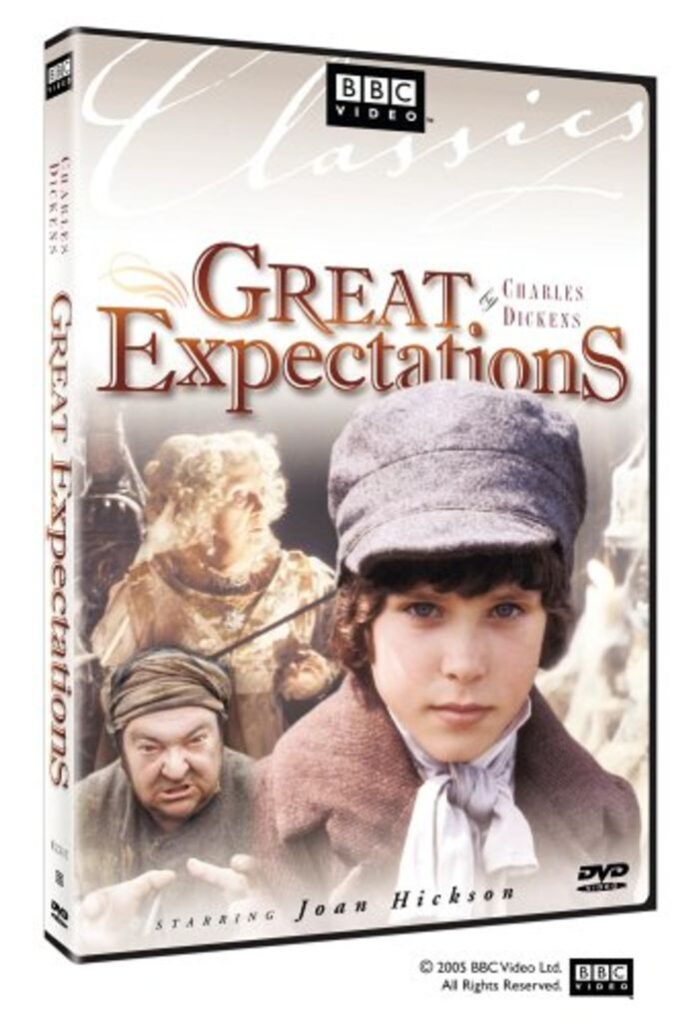
Dickens’ oft-filmed novel Great Expectations has been adapted several times for British television. This version was offered as a two-parter in 1980, then distributed to the U.S. in 1981. Gerry Sundquist stars as Pip, a young boy of humble means whose subsequent career in London is subsidized by a mysterious benefactor. Joan Hickson co-stars as the formidable Miss Havisham, who may be Pip’s mysterious sponsor, while Stratford Johns also appears in a pivotal role. 300 minutes. Written by James A. Hall, produced by Barry Letts, and directed by Julian Amyes.
Nothing is left out in this slow, slow film. Even the dialogue is slow as characters at all levels of society talk in the fussy, overly polite manner typical of novels of the time—”I would be much obliged if you were to do me the honour of….” and so on. Phillip Joseph as Joe Gargery appears not only too neat but too young for the blacksmith. The juvenile Estella, a Nordic blonde played by Patsy Kensit, seems unrelated to the mature Estella, a pinched brunette portrayed by Sarah-June Varley. Pip however seems right, apart from his Partridge Family haircuts. The young Graham McGrath looks and acts exactly like the tyke who would grow into Gerry Sundquist as the older Pip. But the juiciest roles in Great Expectations are always Magwitch and Miss Havisham. And they are admirably filled here. Stratford Johns is great both in the early menacing stages and later sentimental bits as the convict. But Joan Hickson (best known for her long-running Miss Marple) is magnificently decadent and self-pitying.
Starring Gerry Sundquist, Tim Munro, Derek Francis and Joan Hickson.
Note: At the start of Great Expectations, Pip is aged seven, the year approximately 1814. (A reference to Pip at nearly twenty-one, in a street illuminated by gas-lamps which were not introduced until 1827, tells us that Pip’s was born in approximately 1807.) Pip is about 34 years old at the end of the story when he returns to England to see Joe, Biddy and their children, placing the date around 1841. Our narrator is telling his story in 1860. So by Willow and Thatch’s calculations, Great Expectations spans the [Regency, Georgian](http://www.willowandthatch.com/period-films-to-watch/period-dramas-georgian-regency-eras/) and [Victorian](http://www.willowandthatch.com/period-films-to-watch/period-dramas-victorian-era/) eras.