
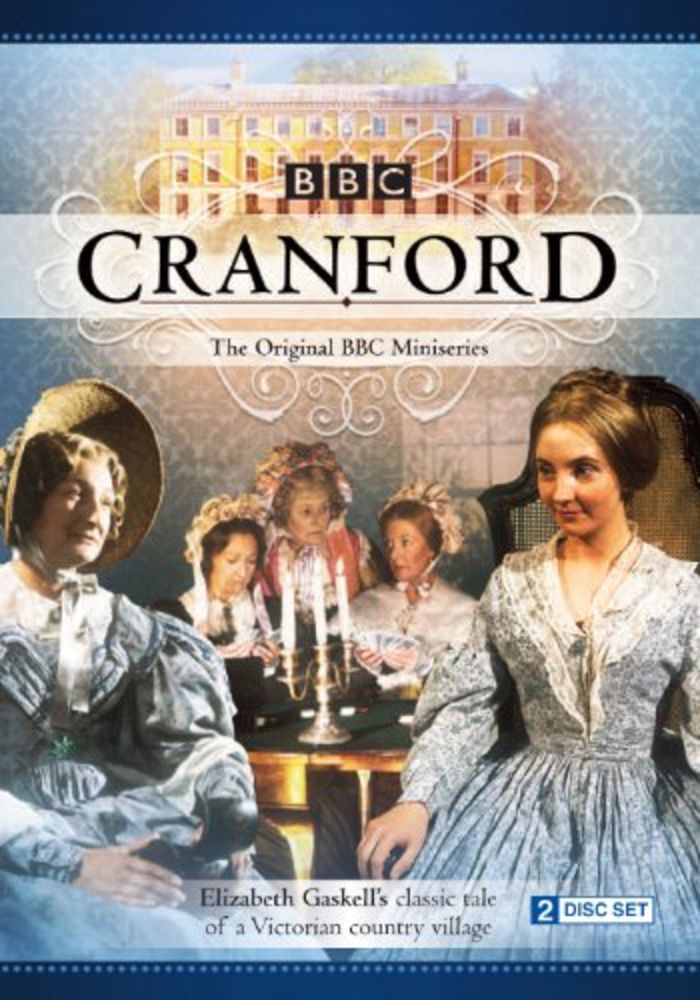
Elizabeth Gaskell’s classic tale of a Victorian country village. Set in the early 1840s, this is the original BBC miniseries of Elizabeth Gaskell’s classic tale of a fictional Victorian country village in which the genteel ladies of Cranford struggle to face an uncertain future with dignity and 19th Century decorum.
Filled with the heartwarming humor and gentle pathos of Elizabeth Gaskell’s classic novel, this original four- part BBC dramatization of Cranford is set in the early 1840s in a fictional market town in northwest England. The story centers on the town’s predominantly single and widowed middle-class female inhabitants who are comfortable with their traditional way of life and adhere to a complex set of social rules. However, the impending arrival of the railway puts Cranford on the cusp of upsetting social changes and the genteel ladies of Cranford struggle to face an uncertain future with dignity and 19th Century decorum. 180 mins
Starring Gabrielle Hamilton, Helen Christie, Fabia Drake.
Note: There are mixed reviews on this original BBC production. The 2007 version received much acclaim and was a tremendous amount of fun; by comparison the 1972 version may feel dated, but “The 1972 version of Cranford certainly succeeds in this sense in being a painstaking reconstruction of the 19th sentry novel, while also furnishing a slice of the discourses of contemporary history, enabling the pat to resonate with the present.” Brenda McKay goes on to say “The 1972 adaptation of Cranford by Michael Vosey is thus read against the backdrop of a proliferous decade, the 1970s, which saw the flowering of dramatizations of fiction by Austen, Dickens, the Bröntes, George Eliot alongside Dostoevsky, Balzac, Flaubert, Henry James and Sartre. Largely conservative and dated, Vosey’s Cranford is nevertheless defined as a radical, modern symbol: compelling in its attempt to relate nineteenth-century culture to twentieth-century analogous issues, the film deals with gender issues such as sexual liberation and cross dressing, all of which can be found, though obliquely at times, on the page, but find their place also on the screen where Gaskell’s all-female community is given a more optimistic representation.”