
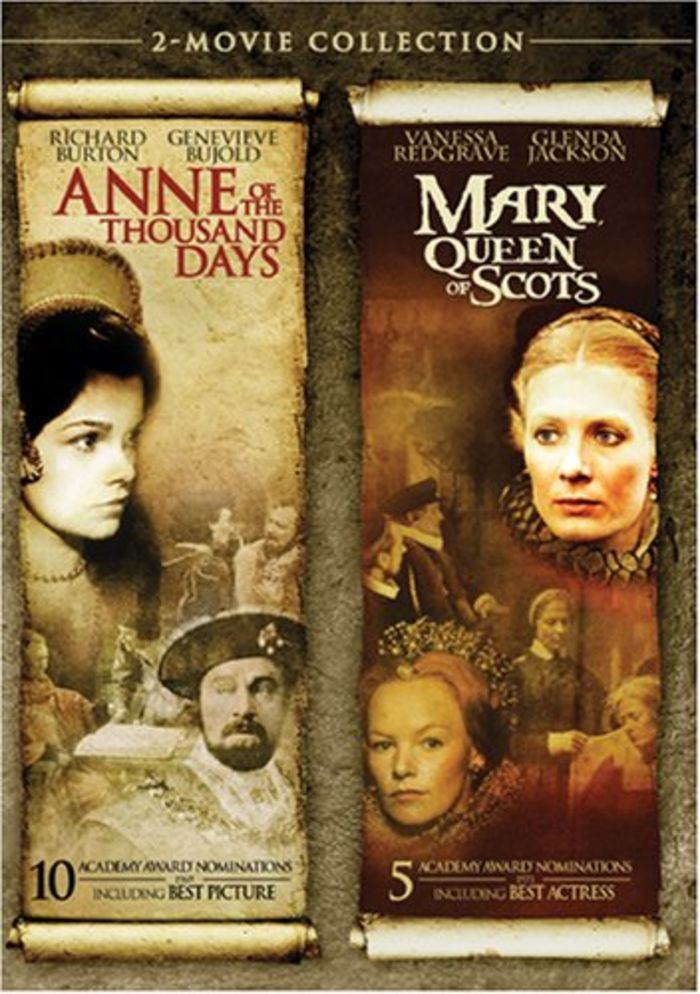
This film adaption of a Broadway play is based on the historical events surrounding the founding of the Church of England. Catherine of Aragon (Irene Papas), empowered wife of King Henry VIII (Richard Burton), has yet to give birth to an heir. King Henry’s wandering eyes fall on the devout and nubile Anne Boleyn (Geneviève Bujold), who refuses his sexual advances. Henry eventually convinces Anne to marry him, but to move forward, the king must face a church that believes divorce is a sin.
Anne of the Thousand Days is the belated film adaptation of Maxwell Anderson’s 1948 stage play. The story concentrates on the romance between Britain’s King Henry VIII (Richard Burton) and his ill-fated second wife Anne Boleyn (Genevieve Bujold). After holding out for marriage rather than an illegitimate union, Anne marries Henry after he sheds himself of Katherine of Aragon — causing a rift between the Crown and the Church in the process. Anne’s inability to produce a male heir leads Henry to look about for other suitable mates. Henry’s sinister right-hand man Cromwell (John Colicos) arranges for Anne to be condemned on a charge of adultery. She is beheaded, while Henry disconsolately sits in Windsor Castle, regretting this callous example of political expediency. Richard Burton is ideally cast in Anne of the Thousand Days, but it is Genevieve Bujold who delivers the best, most complex performance in the film. ~ Hal Erickson, Rovi
Starring Richard Burton, Geneviève Bujold, Irene Papas.
Note: There s also a silent film, [Anna Boleyn (1920)](http://amzn.to/1IpYY4u) starring Henny Porten, Emil Jannings: The story of the ill-fated second wife of the English king Henry VIII, whose marriage to the Henry led to momentous political and religious turmoil in England. “The tragic story of the second wife of England’s Henry VIII is given a first-class treatment by Lubitsch, complete with opulent sets and some beautifully-shot exterior sequences. Henny Porten (Kohlhiesel’s Daughter, Backstairs) gives a memorable performance as Boleyn, but the film really belongs to Emil Jannings (The Last Laugh, The Blue Angel), one of Germany’s greatest screen stars, playing Henry. Jannings’s bravura performance conveys Henry’s decadence through his insatiable appetite for both food and women, but never reduces him to caricature or pure villain. Jannings also establishes the screen model for Henry that would be further developed by Charles Laughton almost fifteen years later in The Private Life of Henry VIII.” – Amazon