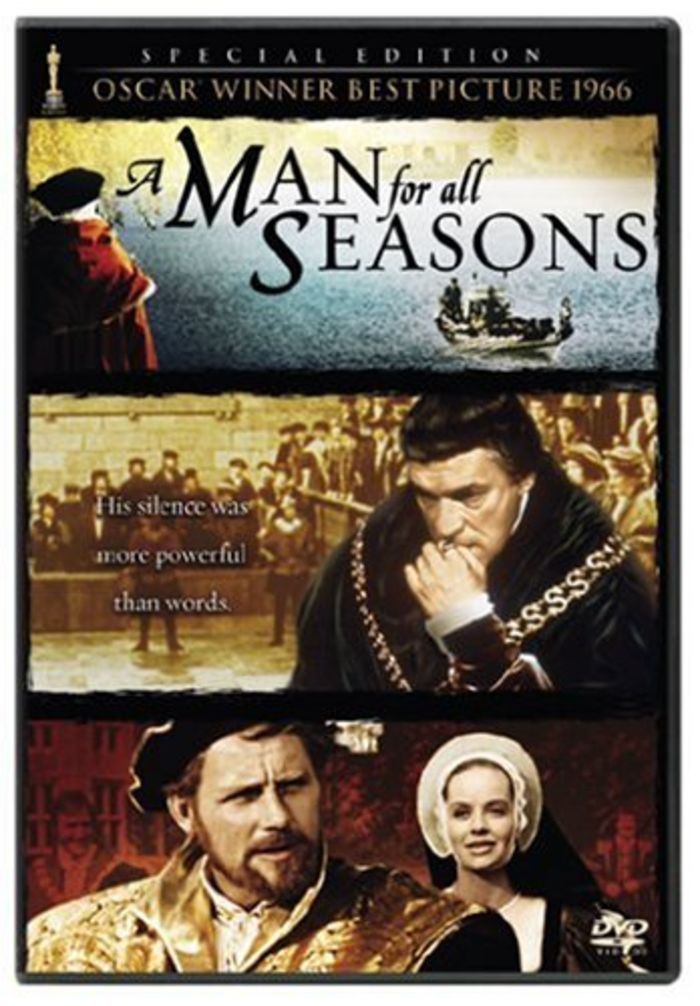
When the highly respected British statesman Sir Thomas More (Paul Scofield) refuses to pressure the Pope into annulling the marriage of King Henry VIII (Robert Shaw) and his Spanish-born wife, More’s clashes with the monarch increase in intensity. A devout Catholic, More stands by his religious principles and moves to leave the royal court. Unfortunately, the King and his loyalists aren’t appeased by this, and press forward with grave charges of treason, further testing More’s resolve.
FRED ZINNEMANN has done a fine job of putting upon the screen the solid substance of “A Man for All Seasons,” Robert Bolt’s play about Sir Thomas More, and in doing so he presents us with an awesome view of a sturdy conscience and a steadfast heart. Within such magnificent settings as only England itself could provide to convey the resplendence and color of the play’s 16th-century mise en scène, and with Paul Scofield playing Sir Thomas as he did so superbly on the stage, Mr. Zinnemann has crystallized the essence of this drama in such pictorial terms as to render even its abstractions vibrant. – NYT
Robert Bolt’s successful play was not considered a hot commercial property by Columbia Pictures–a period piece about a moral issue without a star, without even a love story. Perhaps that’s why Columbia left director Fred Zinnemann alone to make A Man for All Seasons, as long as he stuck to a relatively small budget. The results took everyone by surprise, as the talky morality play became a box-office hit and collected the top Oscars for 1966. At the play’s heart is the standoff between King Henry VIII (Robert Shaw, in young lion form) and Sir Thomas More (Paul Scofield, in an Oscar-winning performance). Henry wants More’s official approval of divorce, but More’s strict ethical and religious code will not let him waffle. More’s rectitude is a source of exasperation to Cardinal Wolsey (Orson Welles in a cameo), who chides, “If you could just see facts flat on without that horrible moral squint.” Zinnemann’s approach is all simplicity, and indeed the somewhat prosaic staging doesn’t create a great deal of cinematic excitement. But the language is worth savoring, and the ethical politics are debated with all the calm and majesty of an absorbing chess game. –Robert Horton
Starring Paul Scofield, Wendy Hiller, Robert Shaw, Leo McKern, Nigel Davenport, John Hurt, Corin Redgrave.