
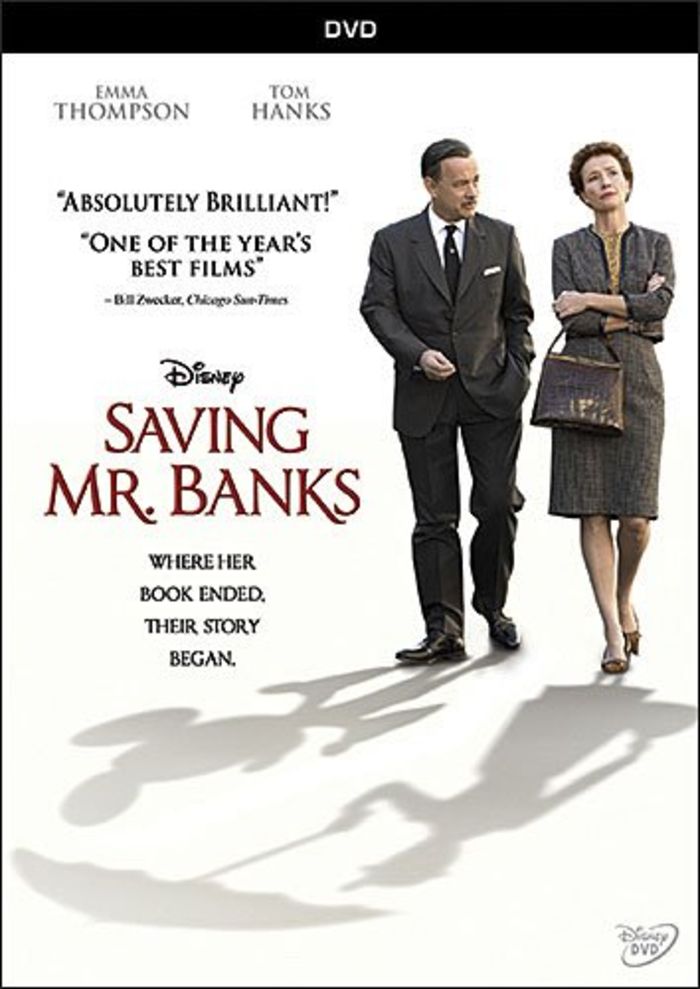
Author P.L. Travers reflects on her Edwardian era childhood after reluctantly meeting with Walt Disney, who seeks to adapt her Mary Poppins books for the big screen.
Age 13+ “Sweet peek behind Poppins story, with very dark moments.”- Common Sense Media
When Walt Disney’s daughters begged him to make a movie of their favorite book, P.L. Travers’ Mary Poppins (1964), he made them a promise – one that he didn’t realize would take 20 years to keep. In his quest to obtain the rights, Walt comes up against a curmudgeonly, uncompromising writer who has absolutely no intention of letting her beloved magical nanny get mauled by the Hollywood machine. But, as the books stop selling and money grows short, Travers reluctantly agrees to go to Los Angeles to hear Disney’s plans for the adaptation. For those two short weeks in 1961, Walt Disney pulls out all the stops. Armed with imaginative storyboards and chirpy songs from the talented Sherman brothers, Walt launches an all-out onslaught on P.L. Travers, but the prickly author doesn’t budge. He soon begins to watch helplessly as Travers becomes increasingly immovable and the rights begin to move further away from his grasp. It is only when he reaches into his own childhood that Walt discovers the truth about the ghosts that haunt her, and together they set Mary Poppins free to ultimately make one of the most endearing films in cinematic history.
The first story is of P.L. Travers’s childhood in Australia in the early 1900s. This story starts out idyllically enough, emphasizing her father’s immense love for his children and his uncanny ability to make everything fun and exciting, but it’s one that has a darker side that ends up shaping the adult that Travers eventually becomes. The other story is of the adult P.L. Travers. A proper Englishwoman completely set in her ways, she grudgingly embarks on a trip from England to Los Angeles to discuss the possibility of turning her highly successful book Mary Poppins into a Disney motion picture. Walt Disney has a vested personal interest in the project, but Travers and the Disney team clash on virtually every level and their interactions run the gamut from perplexing to infuriating and downright funny. The juxtaposition of the two stories is quite masterful, with the stories continually intertwining and each shedding light on the other to create a cohesive film that is highly engaging and emotionally poignant. The casting of Tom Hanks as Disney and Emma Thompson as Travers is inspired: they are absolutely perfect in their roles. Perhaps the most intriguing thing about this film is that Saving Mr. Banks creates a whole new perspective from which to view the beloved original Mary Poppins. (Ages 10 and older) –Tami Horiuchi
Starring Emma Thompson, Tom Hanks, Annie Rose Buckley.
May be suitable for older children.
Parents need to know that while Saving Mr. Banks is about the making of a classic family movie, some of the topics — alcoholism, suicide, and a difficult childhood — might be tough for younger kids to handle. While there are plenty of lighthearted moments to entertain tween and teen viewers, the surprisingly sad moments can be a bit jarring — including a very sick man on his deathbed and a woman attempting suicide in front of her daughter. Parents should consider whether kids are ready for these subjects — or if they’d even enjoy a movie that bounces back and forth between silly and serious. – Common Sense Media