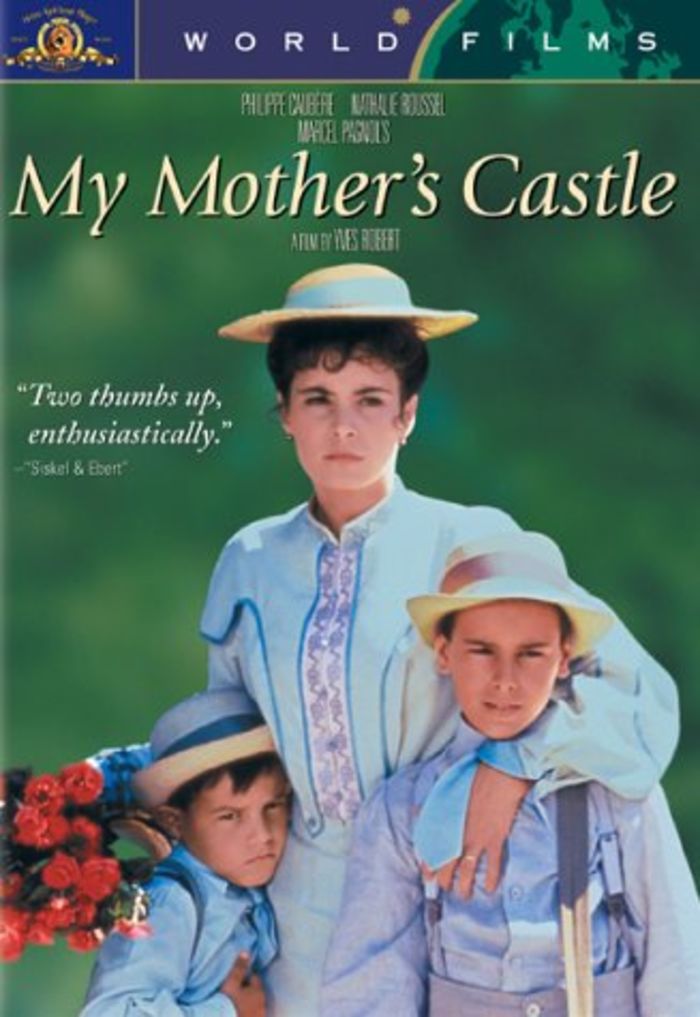
The second part of Yves Robert’s filming of Marcel Pagnol’s childhood memoirs completes the narrative so casually begun in My Father’s Glory–and fulfills a radiant journey we hadn’t even realized we’d embarked on. Marcel is approaching his teens and acquiring a more coherent sense of the world. Accordingly, My Mother’s Castle boasts a more concentrated style and unspools its story over (mostly) the space of one year, as opposed to a dozen. Whereas in the first film Robert had worked entirely with little-known players who simply became Marcel’s family, here he calls upon screen veterans Jean Rochefort, Jean Carmet, and Georges Wilson to flesh out sharply ironical figures who loom challengingly on the young man’s horizon. Consistent with Pagnol’s emphasis on Provençal locations, the focal event of the film becomes the weekly walk the Marseilles-based family makes from the trolley station to their remote country cottage–a quintessentially mundane ritual that comes to be fraught with wonder, delight, and terror. It all leads to a payoff that opens the meaning of the title only as the film is reaching its transcendent conclusion. –Richard T. Jameson
This second film, like the first, is raised to the heights of voyeuristic pleasure by countless family feasts, happy occasions, warm smiles and intoxicating memories. Freshly baked breads are the size of skateboards. Children always appear in crisply starched clean clothes, even in the country, and their mothers never look the least bit overworked. Marcel’s father shaves outdoors, looking into a mirror hung from a tree, humming to himself as he surveys the hills of his beloved countryside. At the end of a long, dusty journey to this remote spot, a man opens an enormous chocolate Easter egg to release a white dove. These films’ greatest accomplishment, in light of so frankly magical a child’s-eye view of the world, is that they maintain enough restraint to keep the prettiness from becoming overwhelming. In “My Mother’s Castle,” even more than in the earlier film, that restraint grows naturally out of the hindsight that shapes these recollections. – NYT
There are little of the usual commercial elements in either of these films – little action, plotting, suspense, romance. But there is love and happiness, and how often do you find those anywhere, let alone at the movies? My Mother’s Castle” begins where “My Father’s Glory” ended, after a brief look back. (It is best to see the films in order, even though this one is complete in itself.) The effect of the two films is a long, slow, subtle buildup to the enormous emotional payoff at the end of the second film, a moment when gratitude and regret come flowing into the heart of the narrator. – Roger Ebert
Starring Julien Ciamaca, Philippe Caubère, Nathalie Roussel, Didier Pain, Thérèse Liotard.
In French with English subtitles, or dubbed in English.