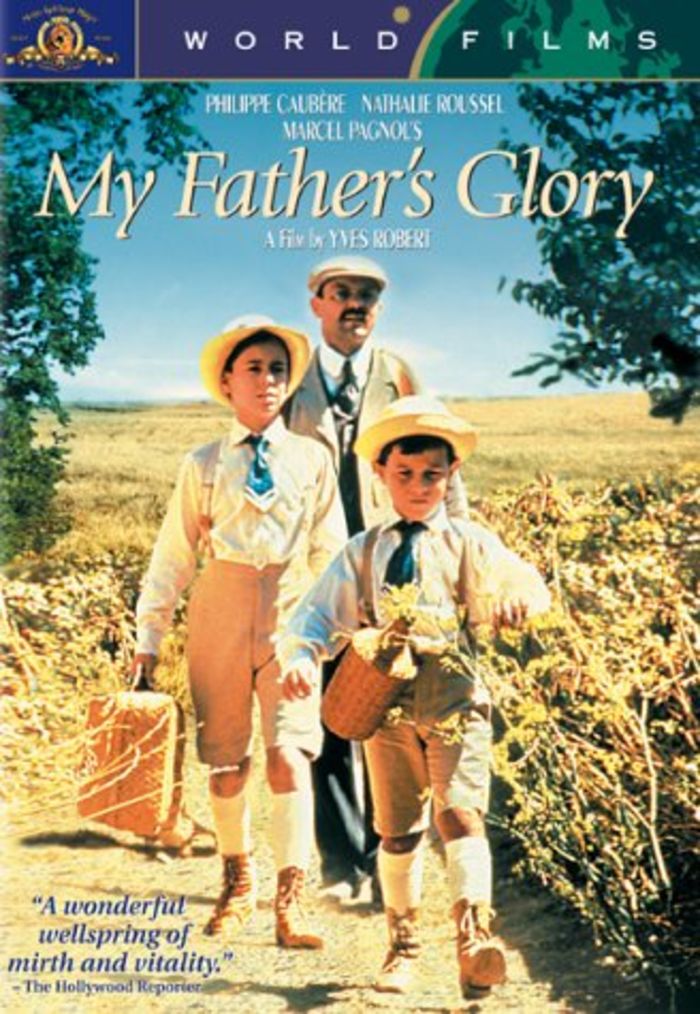
Based on the best-selling memoirs of French novelist/filmmaker Marcel Pagnol, this captivating recollection of a young boy’s life in turn-of-the-century South of France is an intelligent, emotionallyrealistic account of a more idyllic time. A glorious celebration of family, this is one of the most beguiling films since charm went out of fashion (Time)! Among the intoxicating hills of rustic Bastide Neuve, young Marcel and his family experience an unforgettable summer holiday. Marcel, mystified by nature, eagerly turns to his father, Joseph, for an education on the ways of the wild.But Joseph comes up short in Marcel’s eyes when cantankerous Uncle Julesan experienced woodsmanproves to be far more knowledgeable. To redeem himself, Joseph challenges Jules to a hunting matchto prove once and for all that he is not only the patriarch but a father who deserves respect.
Among the bounteous literary and cinematic legacy of Marcel Pagnol, poet laureate of Provence, is a two-volume memoir, My Father’s Glory and My Mother’s Castle. The enormous success of Jean de Florette and Manon of the Spring (Claude Berri’s 1986 remakes of two Pagnol films from the ’50s) encouraged Yves Robert to shoot another Pagnol diptych. Like Garlaban, the great bluff overhanging Pagnol’s childhood home, the result is “less than a mountain, much more than a hill.” The first part, My Father’s Glory, spans Marcel’s early years from infancy to preteen. The film keeps faith with its juvenile subject, leaping from one quirky detail of landscape, character, or biography to the next–whatever has caught the child’s fancy and lingered in the adult narrator’s memory. This makes for episodic storytelling, but it’s an appropriate way to reflect childhood experience, and it doesn’t prevent Robert from developing loving portraits of Pagnol’s nearest and dearest, or paying luminous tribute to the Provençal countryside Pagnol loved. You can almost feel the sunshine, smell the wild thyme. –Richard T. Jameson
The movie has a deliberate nostalgic tone. It is most definitely intended as a memory. The narrator’s voice reminds us of that, but the nature of the events makes it clear, too. What do we remember from our childhoods? If we are lucky, we recall the security of family rituals, our admiration for our parents, and the bittersweet partings with things we love. Childhood ends, in a sense, the day we discover that summer does not last forever. – Roger Ebert
Starring Philippe Caubère, Nathalie Roussel, Didier Pain, Thérèse Liotard, Julien Ciamaca.
In French with English subtitles, or dubbed in English.
Parents need to know that this G-rated French film based on the memoirs of novelist Marcel Pagnol won’t feel quite as G-rated to some American viewers. Boys frolic naked (everything is visible) while bathing outdoors, Marcel’s mom is shown breastfeeding, there’s a lot of talk about how babies are born (and the wrong conclusion is reached), and boys smoke sticks in the country. Also, Marcel’s dad works hard to become a competent hunter and eventually shoots two birds. This story takes place in 1900 showing kids what a typical school looked like back then and shows the beauty of the untamed French countryside. – Common Sense Media