
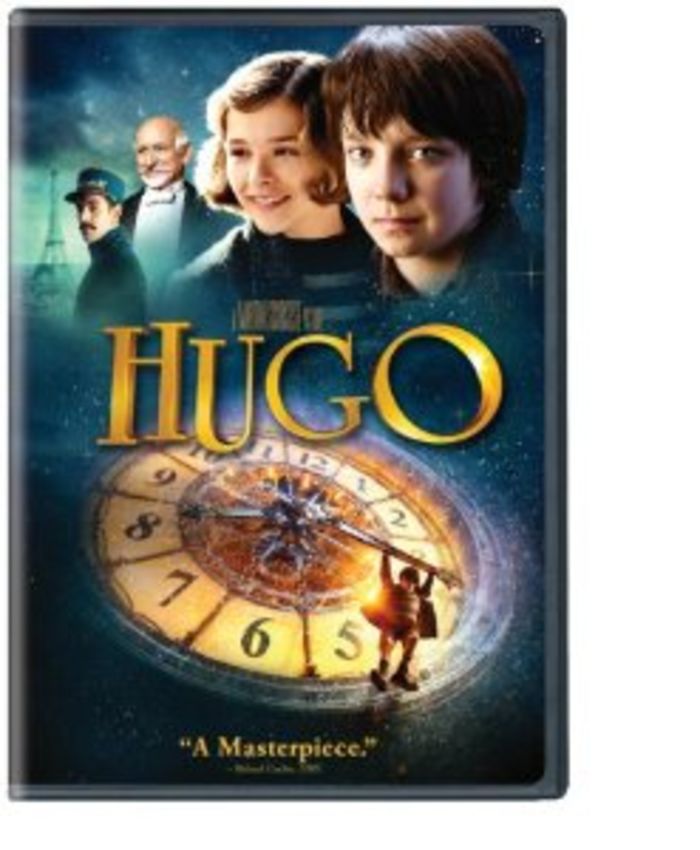
Hugo is a fantasy adventure that takes place in a Paris railway station in the early 1930s. Hugo Cabret is a young boy whose mother has died and who lives with his father, a master clockmaker, who takes him to see films and loves the films of Georges Méliès best of all. Hugo’s father dies in a museum fire, and he is taken away by his uncle, an alcoholic watchmaker who is responsible for maintaining the clocks in the railway station. His uncle teaches him to take care of the clocks, and disappears. Hugo lives between the walls of the train station, maintaining the clocks, stealing food and working on his father’s most ambitious project: a broken automaton-a mechanical man who is supposed to write with a pen, that Hugo’s father had found and hoped to repair. Hugo steals mechanical parts in the station to repair the automaton, but he is caught by a toy store owner, who takes away Hugo’s blueprints for the automaton. The automaton is missing one part-a heart-shaped key. Convinced that the automaton contains a message from his father, Hugo goes through desperate lengths to fix the machine. He gains the assistance of Isabelle, a girl close to his age and the goddaughter of the toy shop owner, and he introduces Isabelle to the movies, which her godfather has never let her see. Isabelle turns out to have the key to the automaton, which unlocks it to produce a drawing of a film scene Hugo remembers his father telling him about. They discover that the film was created by Georges Méliès, Isabelle’s godfather, an early – but now neglected and disillusioned – cinema legend, and that the automaton was a beloved creation of his from his days as a magician. In the end they reconnect Georges with his past and with a new generation of cinema aficionados which has come to appreciate his work.
“Hugo” is unlike any other film Martin Scorsese has ever made, and yet possibly the closest to his heart: a big-budget, family epic in 3-D, and in some ways, a mirror of his own life. We feel a great artist has been given command of the tools and resources he needs to make a movie about — movies. That he also makes it a fable that will be fascinating for (some, not all) children is a measure of what feeling went into it. – Roger Ebert
Hugo is a moving, funny and exhilarating film, an imaginative history lesson in the form of a detective story. The film is a great defence of the cinema as a dream world, a complementary, countervailing, transformative force to the brutalising reality we see all around us. Hugo becomes involved with an old man when he’s accused of theft and has a cherished book of drawings confiscated. He is then assisted by 12 year old Isabelle in retrieving the book, and in turn, when he discovers she’s forbidden to go to the movies, he takes her on a great “adventure”, a visit to the lost world of silent movies at a season of old films. The literate Isabelle is a great admirer of Dickens, and a succession of clever Dickensian twists ensue as the labyrinthine plot takes the pair on a journey into a mysterious past. They discover the origins of the movies in the late-19th-century careers of the Lumière brothers, who put on the first picture show in Paris in 1895 – The Guardian
Starring Ben Kingsley, Sacha Baron Cohen, Jude Law, Asa Butterfield, Chloë Grace Moretz, Ray Winstone, Emily Mortimer, Christopher Lee, Helen McCrory.
Parents need to know that although this book-based period adventure about the art and magic of movies is rated PG, it may be a tad too mature for younger elementary school-aged kids. – Common Sense Media