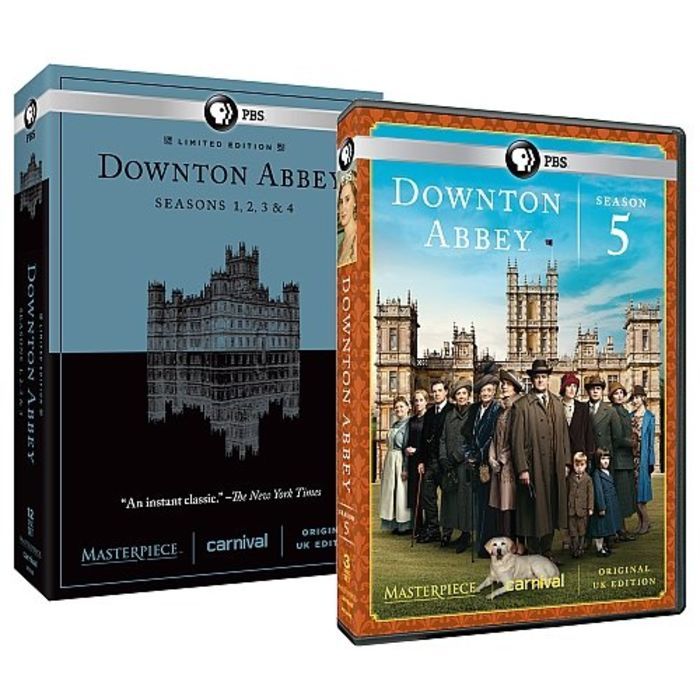
Written and created by Academy Award-winner Julian Fellowes, Downton Abbey has garnered a plethora of praise from critics and fans worldwide. The acclaimed ensemble cast brings to life all the drama and intrigue of the inhabitants of Downton Abbey, the lavish English country manor, home to the Earls of Grantham since 1772. A Golden Globe and multi-Emmy Award-winning series, following the Crawley family and their servants from pre-war England through the storms of World War I, and into the social upheaval of England in the Roaring 1920s as the lives of its inhabitants are shaped by romance, heartbreak, scandals, rumors, blackmail, and betrayal.
“Compulsively watchable from the get-go.” – Variety
“An instant classic.” – The New York Times
Starring Elizabeth McGovern, Hugh Bonneville, Maggie Smith and Maggie Smith Michelle Dockery.
Set between 1912 and 1925, Downton Abbey spans the Edwardian Era, World War I, and the Interwar era.
Shown on PBS Masterpiece Theatre.
Note: The first series of seven episodes explores the lives of the fictional Crawley family and their servants beginning the day after the historic sinking of the RMS Titanic, April 1912. The second series comprised eight episodes and ran from the Battle of the Somme in 1916 to the 1918 flu pandemic. Series Three of Downton Abbey is composed of eight episodes in addition to a Christmas special. It spans through the year 1920, and ends in 1921. Series four continued the story of the Crawley family and their servants and covers February 1922 into the spring/summer of 1923. Series five covers the months from February to December 1924. Series six picks up six months after the end of Series 5, in 1925. The final episode ends on New Year’s Eve, 1925.
Highclere Castle in north Hampshire is used for exterior shots of Downton Abbey and most of the interior filming. Outdoor scenes are filmed in the village of Bampton in Oxfordshire. First World War trench warfare scenes in France were filmed in a specially constructed replica battlefield for period war scenes near the village of Akenham in rural Suffolk. Alnwick Castle, in Northumberland, was the filming location used for Brancaster Castle in the 2014 Christmas special, which included filming in Alnwick Castle’s State Rooms, as well as on the castle’s grounds, and at the nearby semi-ruined Hulne Abbey on the Duke of Northumberland’s parklands in Alnwick.
A ‘tremendous amount of research’ went into recreating the servants quarters at Ealing Studios because Highclere Castle, where many of the ‘upstairs’ scenes are filmed, ‘was not adequate for representing the “downstairs” life at the fictional abbey’. Researchers visited ‘nearly 40 English country houses’ to help ‘inform what the kitchen should look like’, and production designer Donal Woods said of the kitchen equipment that ‘Probably about 60 to 70 percent of the stuff in there is from that period’. Mrs Beeton’s Book of Household Management is an ‘important guide’ to the food served in the series’, but Highclere owner, and author of Lady Almina and the Real Downton Abbey: The Lost Legacy of Highclere Castle, Lady Carnarvon, states that dinner parties in the era ‘would have been even more over the top’ than those shown. However, she understands the compromises that must be made for television, and adds, “It’s a fun costume drama. It’s not a social documentary.
Mat be suitable for older children.
Parents need to know that there are plenty of adult themes in this popular BBC series — sex, scandal, and cover up; sexual assault; thievery; blackmail; sudden death — but all are handled in very buttoned-up Edwardian English fashion. When an unmarried woman sleeps with a male visitor, both are still completely clothed when the camera cuts away. Both opposite-sex and same-sex couples kiss. There are some sad and/or tense moments (a corpse is dragged down a hallway, a medical procedure is shown in detail, a woman dies in childbirth, a beloved character is raped), but overall Downton Abbey offers the typical costume drama experience, complete with backstabbing sisters (they can be really cruel), out-of-touch but usually well-meaning upper-class characters, and a few scheming servants amidst an otherwise loyal and steadfast house staff. – Common Sense Media