
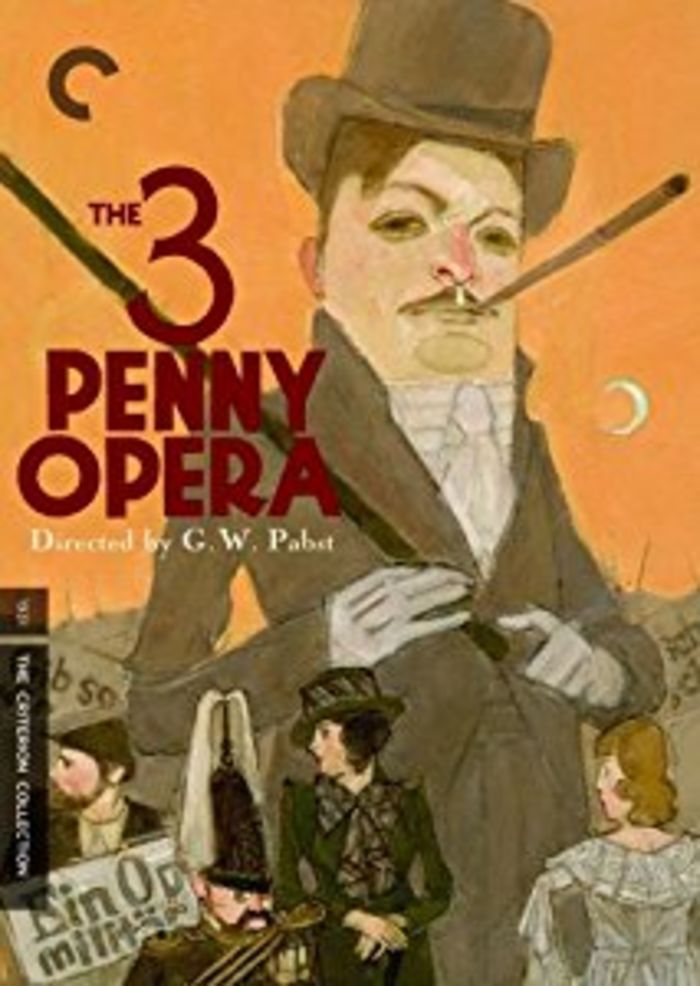
London highwayman Mack the Knife woos the beggar king’s daughter.
The stage version of The Threepenny Opera caused a sensation in Berlin when it opened in 1928, and a movie version was quickly sold and shot. This 1931 film actually differs greatly from the stage production, yet it deserves its status as a classic of Weimar-era Germany (it was banned after the Nazis consolidated their power). Both were based on John Gay’s famous The Beggar’s Opera, but writer Bertolt Brecht and composer Kurt Weill added their own layers of genius. The story revolves around Mackie Messer (played by the fearsomely tough Rudolf Forster), also known as “Mack the Knife,” a London bad boy whose underworld adventures expose all the hypocrisies and squalor of urban life. Those familiar with the stage score will note that the movie cuts a great deal of Weill’s music, in favor of more social criticism; Brecht, high on socialist theory, had largely re-written the play when he turned in his screenplay for the movie. (He was then fired off the project, but many of his new ideas remained.)
The sly melodies of composer Kurt Weill and the daring of dramatist Bertolt Brecht come together on-screen under the direction of German auteur G. W. Pabst (Pandora’s Box) in this classic adaptation of the Weimar-era theatrical sensation. Set in the impoverished back alleys of Victorian London, The Threepenny Opera follows underworld antihero Mackie Messer (a.k.a. Mack the Knife) as he tries to woo Polly Peachum and elude the authorities. With its palpable evocation of corruption and dread, set to Weill’s irresistible score, The Threepenny Opera remains a benchmark of early sound cinema. It is presented here in both its celebrated German and rare French versions.
Starring Lotte Lenya, Rudolf Forster.
In German with English subtitles.
L’opera de quat’sous is Pabst’s French-language version of the film, starring Albert Prejean and Florelle