
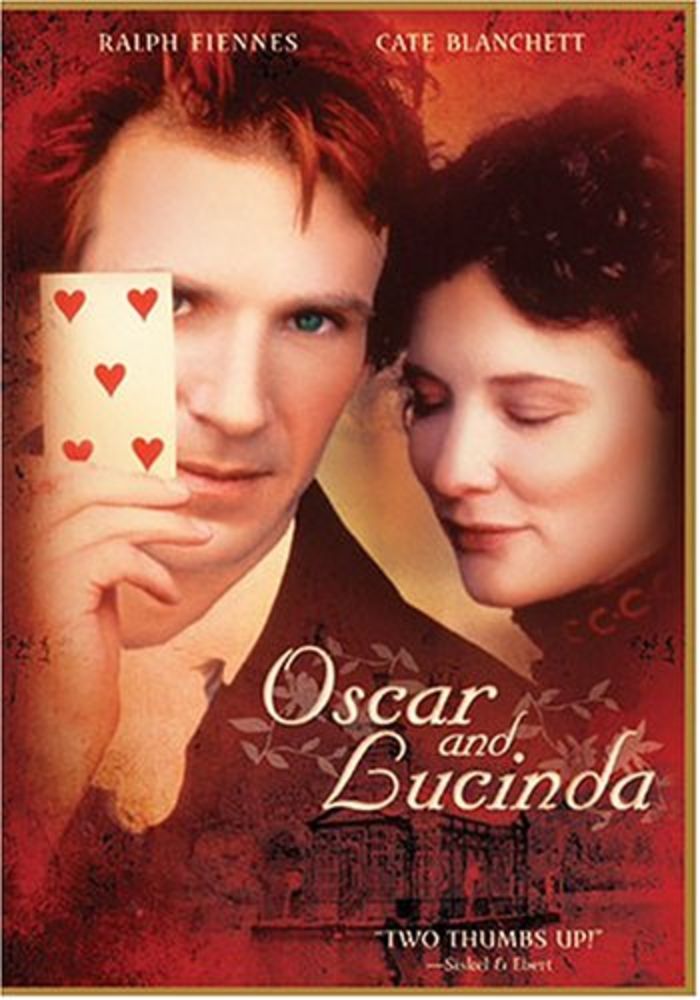
In mid-1800’s England, Oscar (Ralph Fiennes) is a priest who gambles discreetly and donates his winnings to help the poor. Lucinda (Cate Blanchett) is an Australian businesswoman who boldly defies society’s rules. When they meet over an innocent game of cards, their lives are changed forever.
“Oscar and Lucinda” is based on a novel by Peter Carey, a chronicler of Australian eccentricity; it won the 1988 Booker Prize, Britain’s highest literary award. The film’s photography, by Geoffrey Simpson, begins with standard, lush 19th century period evocations of landscape and sky, but then subtly grows more insistent on the quirky character of early Sydney, and then cuts loose altogether from the everyday in the final sequences involving the glass church. In many period films, we are always aware that we’re watching the past: Here Oscar and Lucinda seem ahead of us, filled with freshness and invention, and only the narration (by Geoffrey Rush of “Shine”) reminds us that they were, incredibly, someone’s grandparents. “Oscar and Lucinda” begins with the look of a period literary adaptation, but this is not Dickens, Austen, Forster or James; Carey’s novel is playful and manipulative, and so is the film. – Roger Ebert