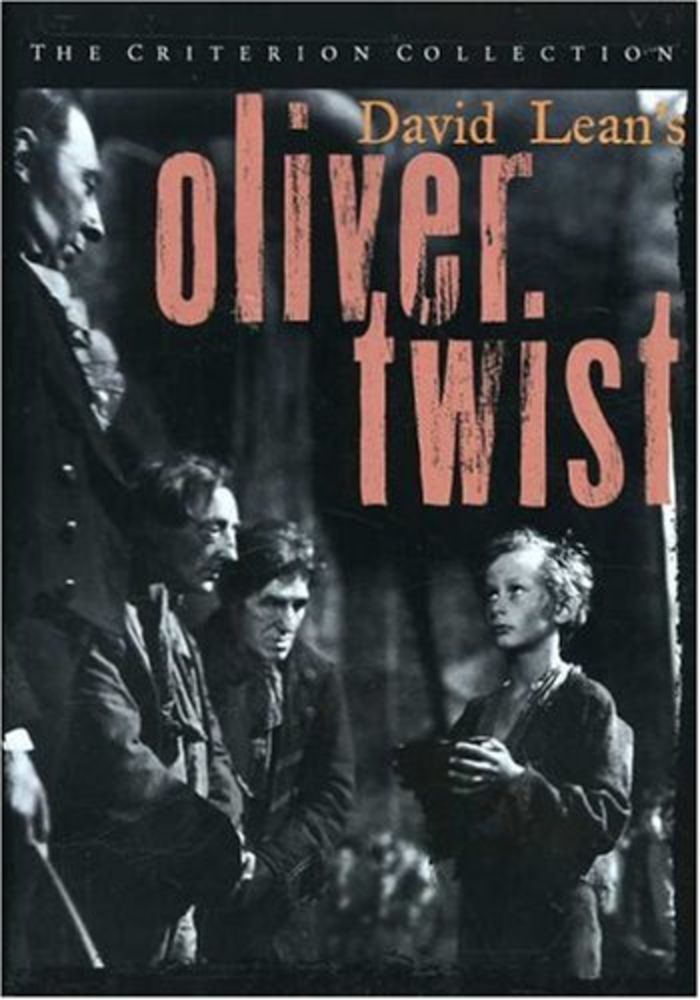
Expressionistic noir photography suffuses David Lean’s Oliver Twist with a nightmarish quality, fitting its bleak, industrial setting. In Dickens’ classic tale, an orphan wends his way from cruel apprenticeship to den of thieves in search of a true home. Here Alec Guinness is the quintessential Fagin, his controversial performance fully restored in Criterion’s new digital transfer.
David Lean’s 1948 version of Charles Dickens’ classic novel begins with a bang: the young hero’s pregnant mother fighting her way through a storm, a perfect metaphor for Oliver’s difficult road ahead. Set in a world of slums in the shadow of Victorian England, the story traces the boy’s life in a workhouse and then with a gang of little pickpockets. A stark but good-looking film shot around some impressive sets, Lean’s immortal adaptation is perhaps best known for Alec Guinness’s remarkable (and slightly controversial) performance as Fagin, the old mentor to the gang of boy thieves. –Tom Keogh
Starring Robert Newton, Alec Guinness, Kay Walsh, John Howard Davies, Francis L. Sullivan.
Note: Though many consider this a brilliant and near flawless film, there was controversy. Guinness wore heavy make-up, including a large prosthetic nose, to make him look like the character as he appeared in George Cruikshank’s illustrations in the first edition of the novel, and this was considered anti-semitic by some as it was felt to perpetrate Jewish racial stereotypes. The March 1949 release of the film in Germany was met with protests outside the Kurbel Cinema by Jewish objectors. The Mayor of Berlin, Ernst Reuter, was a signatory to their petition which called for the withdrawal of the film. The depiction of Fagin was considered especially problematic in the recent aftermath of the Holocaust. As a result of objections by the Anti-Defamation League of B’nai B’rith and the New York Board of Rabbis, the film was not released in the United States until 1951, with seven minutes of profile shots and other parts of Guinness’s performance cut. It received great acclaim from critics, but, unlike Lean’s Great Expectations, another Dickens adaptation, no Oscar nominations. Beginning in the 1970s, the full-length version of Lean’s film began to be shown in the United States. It is that version which is now available on DVD.