
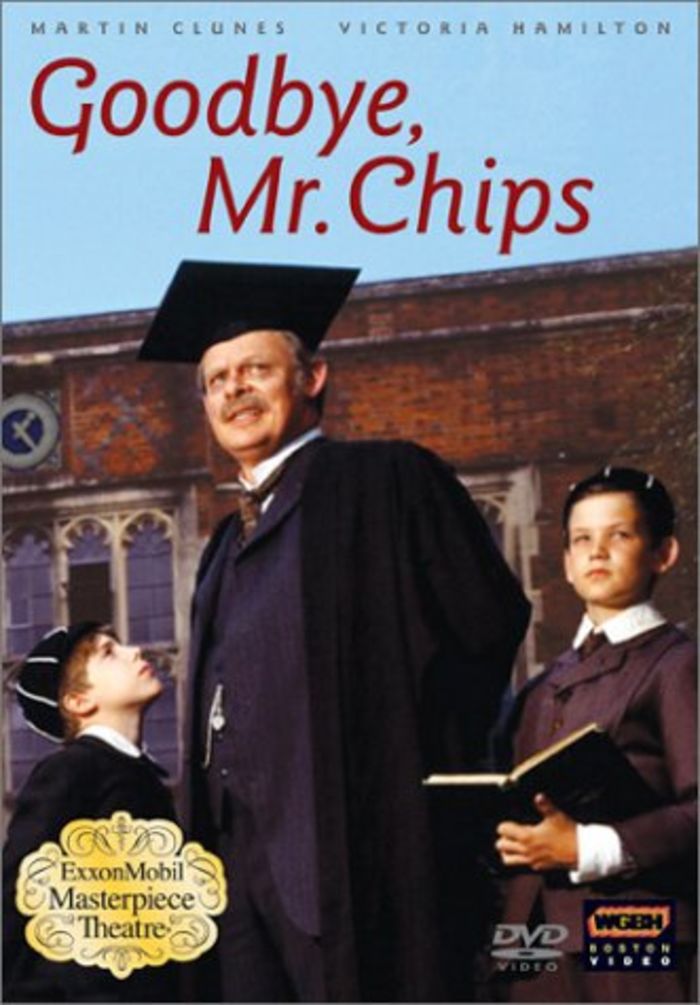
He went from teacher to legend in one lifetime.
Arthur Chipping, the Latin master at an English boys’ boarding school, is as awkward as he is stubborn. The eccentric schoolmaster lives a full, rich life within the cloistered school, defined by his role as the intellectual shepherd of generations of young students. Then, everything changes.
When Mr. Chipping travels through the countryside on summer holiday, he unexpectedly falls in love with the unconventional Kathie (Victoria Hamilton, Mansfield Park). The love and devotion of his new wife ignites his passion and brings him out of his shell, revealing the sensitivity lying beneath his gruff exterior. But after tragedy strikes, Chips’ true character is put to the test in the most difficult examination of his life. Ultimately, it is a lesson that will last a lifetime.
Goodbye, Mr. Chips is a tender, heartwarming story that spans over 50 years in one passionate life. Portraying the storied Arthur Chipping in James Hilton’s classic tale of love and transformation, Martin Clunes (Shakespeare in Love) turns in a bravura performance in a film filled with countless noteworthy turns.
In the annals of English boarding schools, few can match the renown of Brookfield, “a good school of the second rank,” with its unforgettable Latin master Mr. Chipping, known to all as “Mr. Chips.” Masterpiece Theatre’s heartwarming new adaptation of James Hilton’s beloved novella stars Martin Clunes as the amiable educator who arrives at Brookfield as a young teacher in the 1870s, and finds himself a venerated old timer in the 1920s with vivid memories of his thousands of children — “all boys.” Also appearing are Victoria Hamilton as Kathie, the fetching young feminist who most improbably becomes Mrs. Chipping; Conleth Hill as fellow teacher and friend Max Staefel; John Wood as headmaster Wetherby and Patrick Malahide as Ralston, the reforming headmaster who is determined to put the vintage Chips out to pasture.
Shown on PBS Masterpiece Theatre.
Note: The film begins in the Victorian era, moves into the Edwardian era, and concludes in the 1920s.