
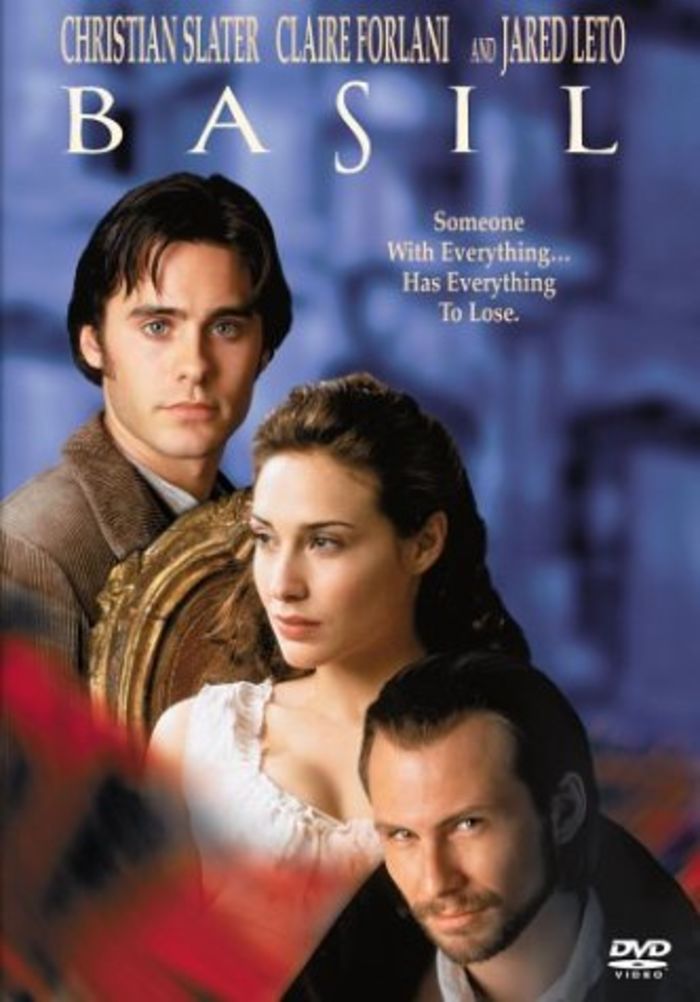
Based on a Victorian novel by Wilkie Collins, Basil is a British-made costume drama that ended up on cable and home video. Jared Leto plays Basil, a well-to-do young aristocrat with an uptight Victorian father (Derek Jacobi). He befriends the mysterious gentleman John Mannion (Christian Slater) and falls in love with the lower-class girl Julia Sherwin (Claire Forlani). His father is upset about his questionable choices and threatens to disown him, thereby renouncing his birthright to inherit Windemere Manor.
Starring Christian Slater, Jared Leto, Claire Forlani.
Note: Most did not like this film, if the reviews are indications of popular sentiment. However, Wilkie Collins fans would do well to read [this article](http://wilkiecollinssociety.org/resurfacing-collinss-basil/) from which the following is excerpted, and to view the film. “Key characters and aspects of the plot remain, but Bharadwaj has determinedly made a much less “sensational,” excessive Basil. One of the glories of Collins’s novel for fans, no doubt, is the way it conducts its various over-the-top frenzies among resolutely domestic settings (calling out perhaps towards directors like Roger Corman or Ken Russell); yet this film’s atmosphere is brooding, clean, and calm. Although we must know that Collins’s labyrinthine plots are not signs of incompetence, but basic to his created world, the film reins in the more “unbelievable” and “ridiculous” aspects of plot and character.
The film version, implicitly and resourcefully, argues that the improbable, labyrinthine twists in Collins’s plot ultimately mask over, or reduce to, repetition and doubling. At first glance, it may appear that the whole budget has gone to pay off Christian Slater, since the interior of Basil’s family mansion consists, for the purposes of filming, almost entirely of the main staircase. The sets remind us that the plot is not progressing, but rather spiralling or repeating. While Collins enacts a turbulent and confusing confrontation with modernity, by contrast, the film version of Basil exudes an airy confidence in its re-enactment of the Victorian. The contemporary Victorian film is and is not a nostalgia film…the final result is that the movie has it both ways: nostalgia and anti-nostalgia at once, cute and sexual, sentimental and political. The film Basil, too, wants us to sympathize with its “rebellions” against Victorian oppression, at the same time that it gives us the serene pleasures and pastoral scenery of masterpiece theater (this Ralph lives out in a country farm, where, after all his mistakes, he finds “the possibility of happiness”). Eternally young and passionate, we are in control of our pasts and presents; we love our enlightened modernity and the way we can make history over into ourselves. Collins’s Basil offers us neither alternative, neither a confident present nor a trouble-free past, and it is on this absence of choice and control that our more knowing, free gaze, in its various overly assured and flexible historicisms, refuses to look.” -Steven Dillon