
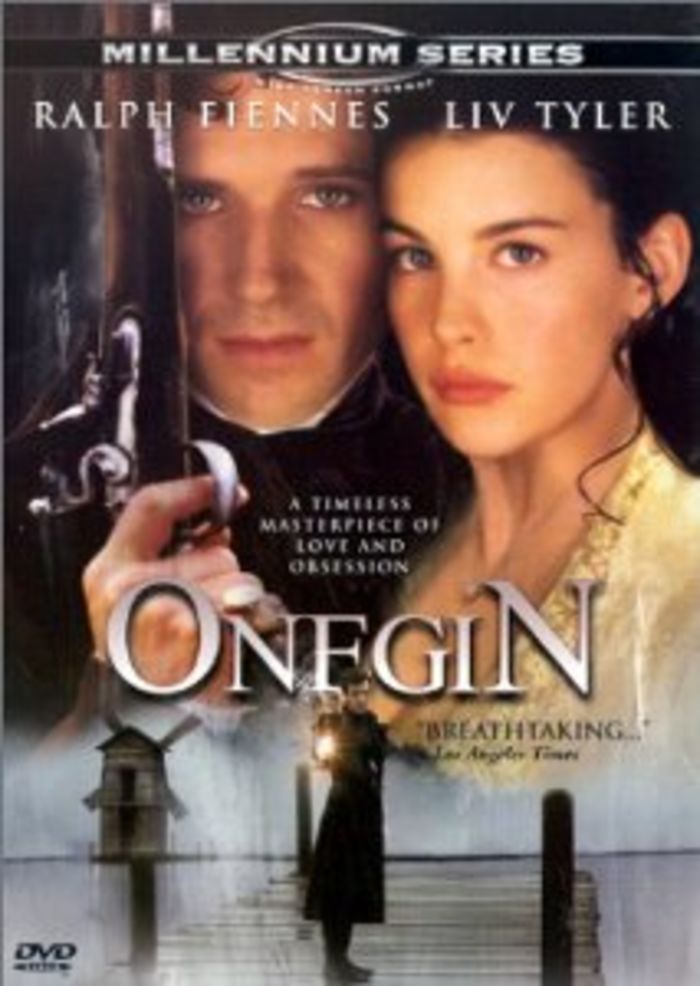
The story centers around a handsome aristocratic man named Eugene Onegin (Ralph Fiennes) who lives during the highly sophisticated Empire period in St. Petersburg. He often grows bored with the mundanity of everyday life, until his best friend Lensky (Toby Stephens) introduces him to a beautiful and passionate woman named Tatiana (Liv Tyler) who changes his view on life forever.
In the 1820s, Eugene Onegin is a bored Saint Petersburg dandy, whose life consists of balls, concerts, parties and nothing more. One day he inherits a landed estate from his uncle. When he moves to the country, he strikes up a friendship with his neighbor, a starry-eyed young poet named Vladimir Lensky. One day, Lensky takes Onegin to dine with the family of his fiancée, the sociable but rather thoughtless Olga Larina. At this meeting he also catches a glimpse of Olga’s sister Tatyana. A quiet, precocious romantic and the exact opposite of Olga, Tatyana becomes intensely drawn to Onegin. Soon after, she bares her soul to Onegin in a letter professing her love. Contrary to her expectations, Onegin does not write back. When they meet in person, he rejects her advances politely but dismissively and condescendingly. This famous speech is often referred to as Onegin’s Sermon: he admits that the letter was touching, but says that he would quickly grow bored with marriage and can only offer Tatyana friendship; he coldly advises more emotional control in the future, lest another man take advantage of her innocence…
Given that for Russians, Pushkin’s poem Eugene Onegin is sort of like Hamlet, Beowulf, and Lord Byron’s Don Juan rolled into one melancholy tale of lost love and ennui among the gentry, it’s surprising Russian filmmakers have balked at adapting the film. Having taken a stage production of Hamlet to Russia where it was rapturously received, self-confessed Slavophile actor Ralph Fiennes must have thought he was making reparation when he executive-produced and starred in this faithful adaptation of the film. With Martha Fiennes on board as director, it’s something of a family affair with more than a little of the solemnity one often discovers in “personal projects”. Pushkin’s romanticism comes across amply, but little of his ferocious wit or, inevitably, the authorial voice that makes the poem so compelling, even in translation. Ralph Fiennes typecasts himself in the title role: his Onegin is yet another of the actor’s wintry, haunted lovers in period dress (this time early 19th century). The character, a jaded roué from St. Petersburg, summers in the countryside where he inadvertently wins the heart of the impulsive Tatyana (Liv Tyler, the girl they book when Gwyneth Paltrow’s busy). Onegin’s casual attitude to her love leads to a tragic duel (magnificently tense and perfectly staged), and years later a chance meeting stirs up feelings of regret, triumph, and moral queasiness. Tears well in eyes, letters are sent and read, furs are ruffled in the snow. This is the highbrow end of costume drama: patrician in its literary purity, and rather admirable in its restraint and good taste, if a little dull. –Leslie Felperin
Starring Ralph Fiennes, Liv Tyler, Toby Stephens, Lena Headey, Martin Donovan.