
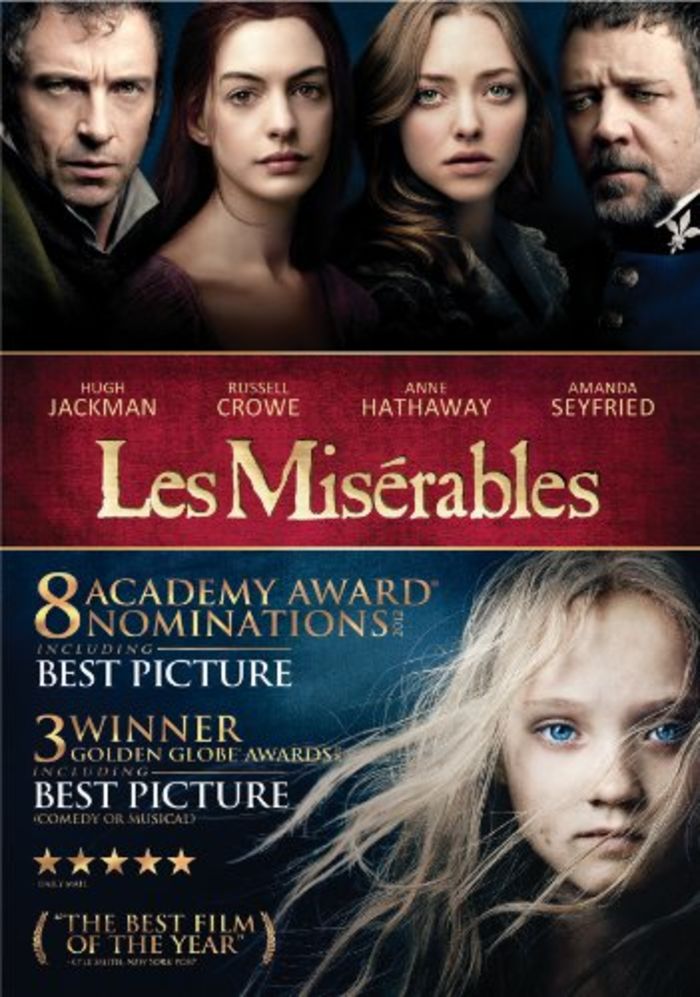
In 19th-century France, Jean Valjean, who for decades has been hunted by the ruthless policeman Javert after breaking parole, agrees to care for a factory worker’s daughter. The decision changes their lives for ever.
Hugh Jackman, Academy Award winner Russell Crowe and Anne Hathaway star in this critically-acclaimed adaptation of the epic musical phenomenon. Set against the backdrop of 19th-century France, Les Misérables tells the story of ex-prisoner Jean Valjean (Jackman), hunted for decades by the ruthless policeman Javert (Crowe), after he breaks parole. When Valjean agrees to care for factory worker Fantine’s (Hathaway) young daughter, Cosette, their lives change forever. This enthralling story is a timeless testament to the survival of the human spirit and “an unforgettable experience” (Richard Roeper, RichardRoeper.com).
Note: Other somewhat recent adaptations of Les Misérables include:
[Les Miserables (1978)](http://amzn.to/1V9mWXh) starring Richard Jordan, Anthony Perkins, Claude Dauphin, John Gielgud.
[Les Miserables (1995)](http://amzn.to/1YB5ob3) musical enacted at the Royal Albert Hall.
[Les Misérables (1998)](http://amzn.to/1V9mGrg) starring Liam Neeson, Geoffrey Rush, Uma Thurman.
[Les Misérables (2000)](http://amzn.to/1V9n2yh) starring Gérard Depardieu, Christian Clavier, John Malkovich.
“No, Les Misérables is not historical fiction about “the French Revolution.” Not the biggie, la grande révolution, 1789-94, the one everybody knows about, featuring Parisians (not “peasants,” please) attacking the Bastille; Marie-Antoinette getting her head cut off; Madame Defarge knitting at the guillotine; and Napoleon somehow taking over at the end and cleaning up the mess. Les Misérables is, among many other things, about the legacy of the French Revolution.
The uprising in the second half of Les Mis is no huge, nation-sized, world-shaking revolution like the 1789 biggie; it’s a relatively small Parisian insurrection, a couple of days of street riots and resistance that did take place in June, 1832 (Victor Hugo witnessed it firsthand), and which was quickly and bloodily suppressed by government troops, just as it is in the novel/musical/film. And if you do your math (1832 minus 1789), you’ll soon figure out that the climax of Les Mis is taking place a good 43 years after la grande révolution, at a time when the Revolution-with-a-capital-R is only a distant memory, for good or evil, in the minds of a very senior generation.” – Susanne Alleyn