
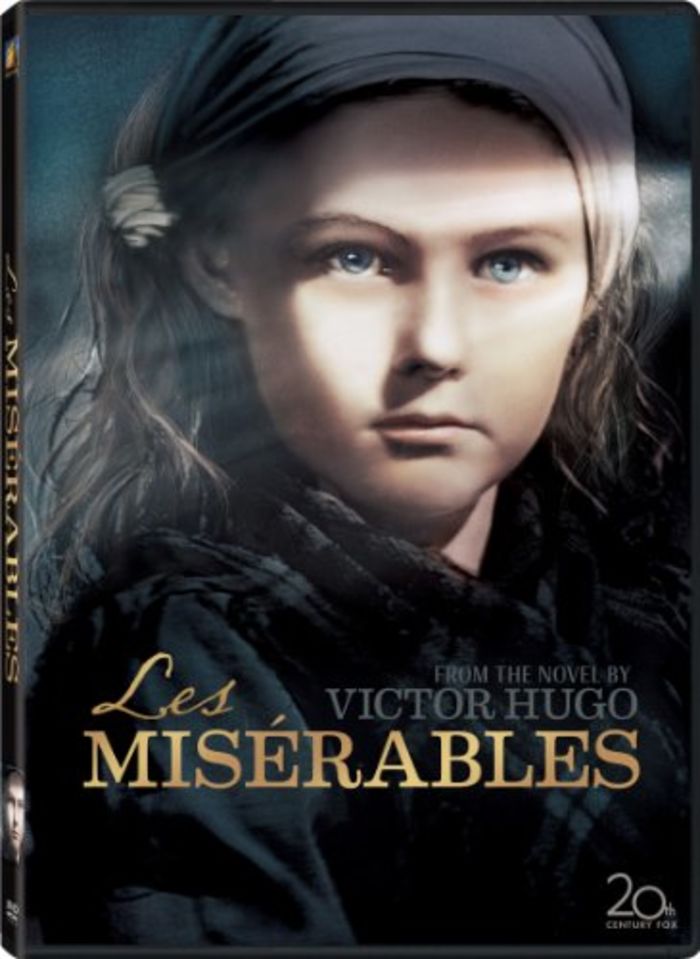
Les Misérables 1935: Victor Hugo’s most acclaimed novel comes brilliantly to life in this impeccably performed, magnificently filmed screen adaptation. Frederic March stars as Valjean, the ex-convict who rises against all odds from galley slave to mayor. Charles Laughton is Javert, the fanatical police inspector who dedicates his life to recapturing Valjean. A vivid depiction of the appalling poverty and social strife of 19th-century France, this version of Les Misérables does splendid justice to the original novel.
Les Misérables 1952: Michael Rennie, fresh from his success in the sci-fi classic The Day The Earth Stood Still cuts a very handsome figure as Jean Valjean, and Debra Paget, who would later reteam with Rennie in four more films, makes for a stunning Cosette in this powerful retelling of the classic epic. Costars include Robert Newton (Treasure Island), Edmund Gwenn (Miracle On 34th Street), Cameron Mitchell (How To Marry A Millionaire), Sylvia Sidney (Mars Attack!) and Elsa Lanchester (The Bride Of Frankenstein)!
Victor Hugo’s massive novel Les Miserables has spawned many adaptations in many forms over the years, and Twentieth Century Fox can count two respectable versions from its studio heyday. Both are included on this single-disc release. The superior version is the lavish 1935 take, for which producer Darryl F. Zanuck marshaled the studio’s resources. While evocatively staged by director Richard Boleslawski and smartly condensed into punchy, vivid scenes, the movie is remembered for its indelible central performances: Fredric March as the hunted Jean Valjean and especially Charles Laughton as his letter-of-the-law pursuer, Inspector Javert. March, a sometimes stagey actor, is at his committed best, notably in the sequence where (in a single-scene second role) he plays the simpleton mistaken for the fugitive Valjean. But Laughton is completely fascinating: cruel and unforgiving, yet neurotic and weak; and Laughton brings out a tortured sexual undercurrent to Javert’s pursuit. (Laughton didn’t get an Oscar nomination for his performance, but he bagged one the same year for Mutiny on the Bounty; the film itself was nominated in four categories, including nods for Best Picture and Gregg Toland’s cinematography.)
The 1952 production is similarly handsome, and director Lewis Milestone (All Quiet on the Western Front) an even more talented filmmaker than Boleslawski. But it misses classic status because of the elusive alchemy of casting. The story may be told serviceably, but Michael Rennie’s Christlike Valjean and Robert Newton’s steadfast Javert don’t catch the magic, giving the result a sort of “Classics Illustrated” quality. But Laughton will haunt your dreams. –Robert Horton
“No, Les Misérables is not historical fiction about “the French Revolution.” Not the biggie, la grande révolution, 1789-94, the one everybody knows about, featuring Parisians (not “peasants,” please) attacking the Bastille; Marie-Antoinette getting her head cut off; Madame Defarge knitting at the guillotine; and Napoleon somehow taking over at the end and cleaning up the mess. Les Misérables is, among many other things, about the legacy of the French Revolution. The uprising in the second half of Les Mis is no huge, nation-sized, world-shaking revolution like the 1789 biggie; it’s a relatively small Parisian insurrection, a couple of days of street riots and resistance that did take place in June, 1832 (Victor Hugo witnessed it firsthand), and which was quickly and bloodily suppressed by government troops, just as it is in the novel/musical/film. And if you do your math (1832 minus 1789), you’ll soon figure out that the climax of Les Mis is taking place a good 43 years after la grande révolution, at a time when the Revolution-with-a-capital-R is only a distant memory, for good or evil, in the minds of a very senior generation.” – Susanne Alleyn