
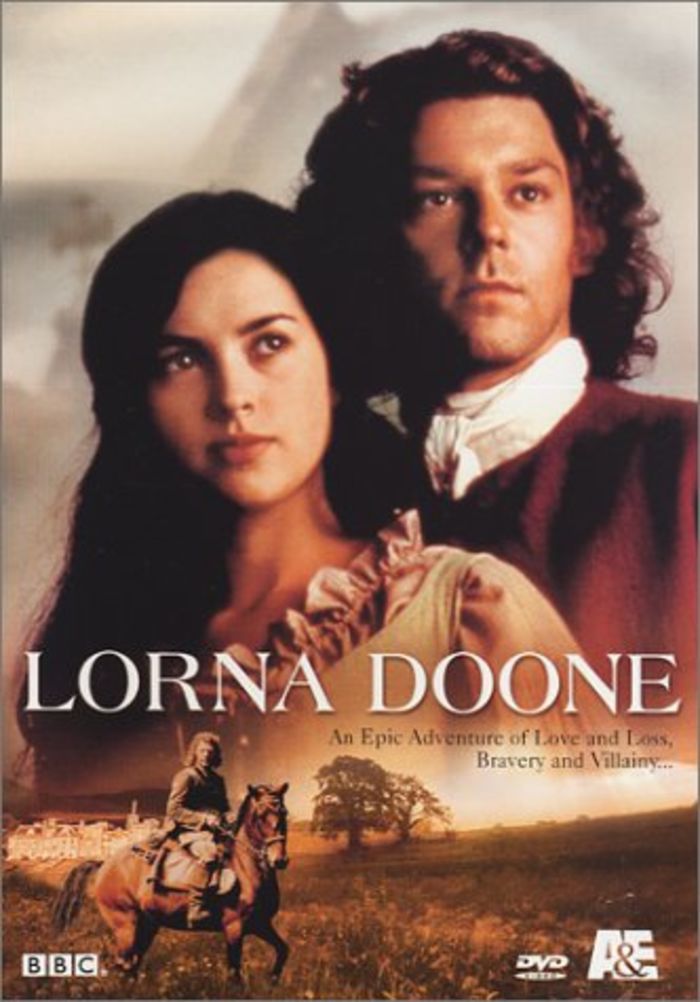
Lorna Doone is a passionate love story set in 17th century rural England, charting the young John Ridd’s search for revenge after his father’s murder, and the chance encounter with beautiful Lorna Doone that changes the course of his life.
Star-crossed lovers, feuding family, royal plots, noble destinies, and salt-of-the-earth heroes. No wonder R.D. Blackmore’s romantic classic has been a perennial favorite. Amelia Warner (Michael Caine’s innocent child bride in Quills) is Lorna, the beautiful young brunette “queen” of the feral Doone clan in this latest adaptation, a handsome 2.5-hour co-production between the BBC and A&E. The once noble line now lives out of a swamp fortress and preys off the local farmers and tradesmen, but the family patriarch (Peter Vaughan) has hatched a plot to win back his title and his land. Handsome John Ridd (Richard Coyle) swears vengeance against the Doones when they murder his father, but he falls for Lorna, and the rakish, ruthless Doone scion (Aiden Gillen, who swaggers through the drama with a perpetual sneer) refuses to give up his claim on the girl without a fight.
This is the kind of British romantic adventure that decries the tradition of nobility and privilege while rewarding its heroes with those very privileges, all within a grand framework of melodramatic twists, thrilling battles, and chivalrous heroics. Director Mike Barker creates an appropriately larger-than-life world at once pastoral and savage for his little epic–shot in the verdant British countryside, where a lush forest green permeates every outdoor scene, while the dusky interiors glow with candlelight–giving in completely to the sweeping emotional melodrama at the core of the story. –Sean Axmaker
Starring Neil Finnighan, Jack Baverstock, Trevor Cooper, Aidan Gillen, Ruth Sheen.
Note: Lorna Doone was published in 1869 and takes place in Devon and Somerset, particularly around the East Lyn Valley area of Exmoor, but the television drama was filmed more than 150 miles north on the Brecon Beacons, in Wales.
The narrator, John Ridd, says he was born on 29 November 1661; in Chapter 24, he mentions Queen Anne as the current monarch, so the time of narration is 1702–1714 making him 40–52 years old. He recounts details of the story as early as 1673 and as late as 1686. Blackmore incorporated real events and places into the novel.
According to the preface, the work is a romance and not a historical novel, because the author neither “dares, nor desires, to claim for it the dignity or cumber it with the difficulty of an historical novel.” As such, it combines elements of traditional romance, of Sir Walter Scott’s historical novel tradition, of the pastoral tradition, of traditional Victorian values, and of the contemporary sensation novel trend. The basis for Blackmore’s historical understanding is Macaulay’s History of England and its analysis of the Monmouth rebellion. Along with the historical aspects are folk traditions, such as the many legends based around both the Doones and Tom Faggus.