
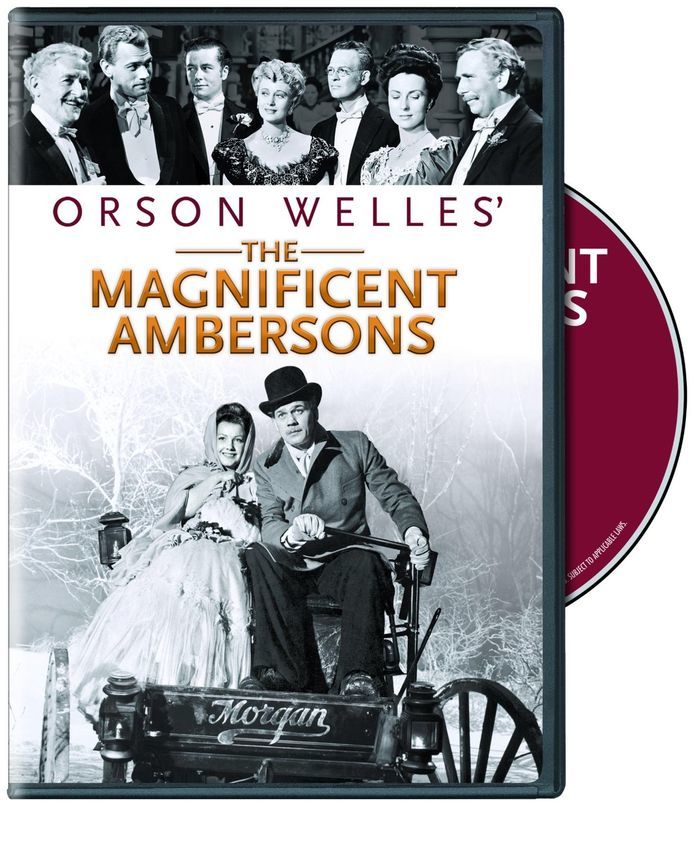
The magnificence of the Ambersons began in 1873. Their splendor lasted throughout all the years that saw their midland town spread and darken into a city. In that town, in those days, all the women who wore silk or velvet knew all the other women who wore silk or velvet, and everybody knew everybody else’s family horse and carriage. The only public conveyance was the streetcar. A lady could whistle to it from an upstairs window, and the car would halt at once and wait for her, while she shut the window, put on her hat and coat, went downstairs, found an umbrella, told the girl what to have for dinner, and came forth from the house. Too slow for us nowadays, because the faster we’re carried, the less time we have to spare. During the earlier years of this period, while bangs and bustles were having their way with women, there were seen men of all ages to whom a hat meant only that rigid, tall silk thing known to impudence as a stovepipe. But the long contagion of the derby had arrived. – Narrator, The Magnificent Ambersons
“The Magnificent Ambersons” is an exceptionally well-made film, dealing with a subject scarcely worth the attention which has been lavished upon it. – NYT
Set in the [Victorian era](http://www.willowandthatch.com/period-films-to-watch/period-dramas-victorian-era/) and the [Edwardian era](http://www.willowandthatch.com/period-films-to-watch/best-period-dramas-edwardian-era/): The story of the film spans two generations (about twenty-five years), and is set at the turn of the century in an upper-middle-class Midwestern American town [Indianapolis, Indiana – identified by the front page of the Indianapolis Inquirer at the end of the film]. This tale is set against the social decline, ruin and fall of the aristocratic Amberson family at the turn of the century with the coming of the industrial age and the rise of the automobile (and the prosperous Morgan family). Industrial and technological progress parallels the decline of the fortunes of the wealthy Amberson family. – Tim Dirks
Nominated for four Academy Awards: Best Picture, Best Supporting Actress (Agnes Moorehead), Best Black and White Cinematography (Stanley Cortez), and Best Black and White Interior Decoration.
Starring Tim Holt, Joseph Cotten, Dolores Costello, Georgia Backus, Anne Baxter, Richard Bennett, William Blees, Ray Collins.