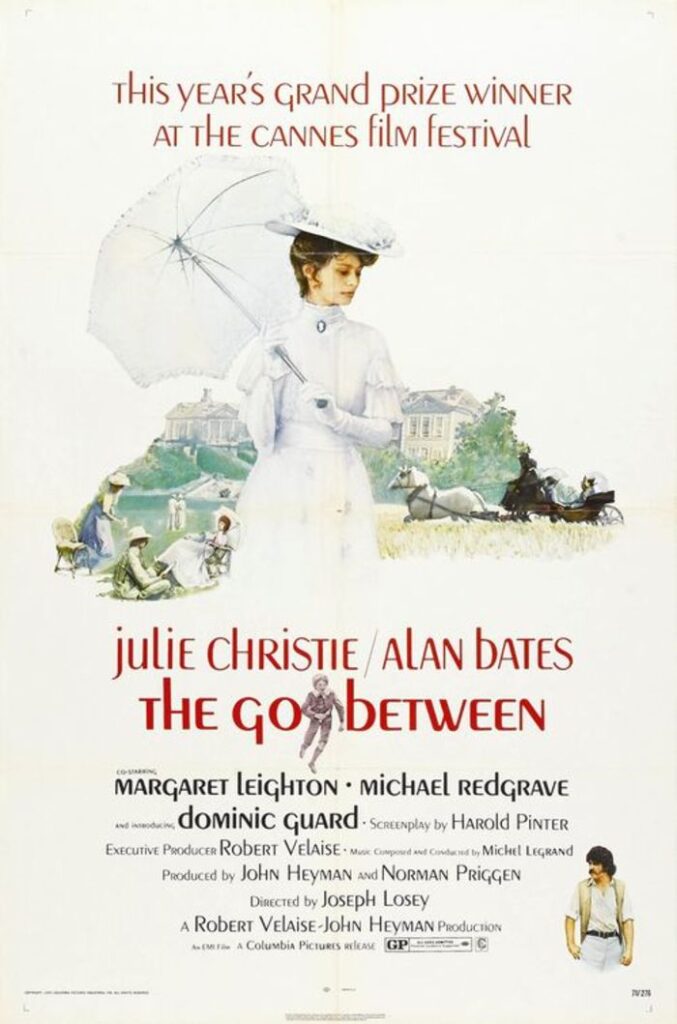
Summer 1900: Queen Victoria’s last and the summer Leo turns 13. He’s the guest of Marcus, a wealthy classmate, at a grand home in rural Norfolk. Leo is befriended by Marian, Marcus’s twenty-something sister, a beauty about to be engaged to Hugh, a viscount and good fellow. Marian buys Leo a forest-green suit, takes him on walks, and asks him to carry messages to and from their neighbor, Ted Burgess, a bit of a rake. Leo is soon dissembling, realizes he’s betraying Hugh, but continues as the go-between nonetheless, asking adults naive questions about the attractions of men and women. Can an affair between neighbors stay secret for long? And how does innocence end?
The cast is splendid and I’m afraid that any listing I may give will sound like a sort of half-baked inventory of superlatives. To cite just a few: Julie Christie, cool and passionate and cruel and sweet, as the heiress who is the principal instrument of Leo’s destruction; Alan Bates, as the tenant farmer she loves and whom she meets in the hayloft at teatime; Margaret Leighton, as the mother who is not without feeling, but puts manners first; and Edward Fox, as the viscount who apparently accepts the scandal since, after all, “nothing is ever a lady’s fault.” The production that Losey has designed for Pinter’s screenplay is close to perfect, with never a shot, a camera angle, nor a cut from one scene to another that is not synchronized to the structure of the whole. Long views of meadows and skies are not simply scenic constables, but memories of events seen fifty years later. When the camera moves in for a close-up—I remember especially vividly one of Miss Leighton on the verge of hysteria—the effect is of the kind of complex, contradictory kind of revelation that only a movie camera can capture. The Go-Between, which won the Grand Prize at the 1971 Cannes Festival, is full of those contradictions that make both life and movies interesting. It’s an idyll about murder, a charming tale of casual cruelty, and a terrifying picture of an innocent love. It’s one of the few new (1971) movies, in fact, that I can recommend without any real qualifications. – Vincent Canby, NYT
Starring Julie Christie, Alan Bates, Margaret Leighton.