
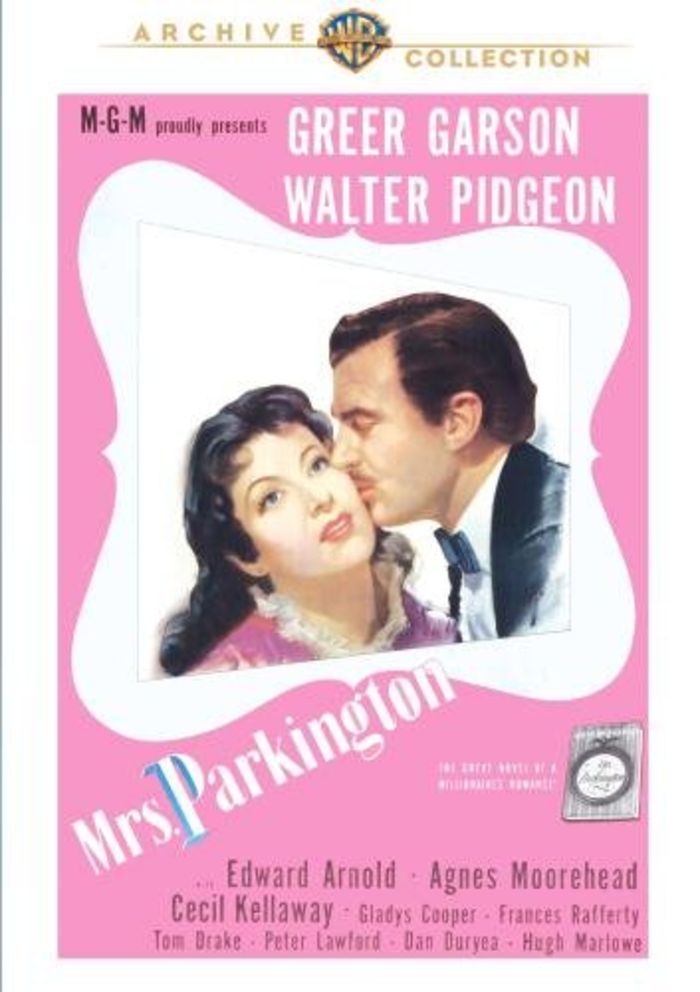
One day in 1872, Susie Graham is making beds at her mother’s Leaping Rock, Nevada, boarding house. The next day, she’s a millionaire’s wife. That millionaire is Major Augustus Parkington, a dashing financial buccaneer who sweeps Susie away to a 5th Avenue mansion and a life of privilege and power. Greer Garson and Walter Pidgeon mark the fourth of their eight beloved film pairings with this grand chronicle (featuring sharp Oscar-nominated performances from Garson and Agnes Moorehead) that begins with Susie as the 84-year-old family matriarch and flashes back on a Christmas Eve to decades of passion, breakups, reconciliations, losses, laughs, schemes and sacrifices. Epic romance, epic adventure: Mrs. Parkington invites you to share her remarkable life.
The story unfolds, in flashback, as the elderly Mrs. Parkington reminisces on Christmas Eve, about her life, love, family, and future. It’s amazing how MGM could edit a multi-generational epic into 2 hours without diminishing the plot to a synopsis. Imagine squeezing the entire 14 seasons of the TV series “DALLAS” into a 2-hour film, as recalled by Miss Ellie on a Christmas Eve, and you pretty much have MGM’s “Mrs. Parkington.” Of course, with Greer Garson being the biggest box office draw of the 1940’s, and Louis B. Mayer’s prize star, you can expect the grand MGM treatment (exquisite black and white cinematography, period costume design, exterior and interior set design, makeup, crystal chandeliers, statuary, antiques, French-stripe wallpaper, “the whole nine yards,” as it were…). But the plot, starting in 19th-century Nevada, ending in 20th-century Manhattan, is the core of the film. The storyline runs the epic trail of hardship, pain, struggle, success, reflection, dilemma, and ultimate grand choice which will determine the future. It’s all there. It’s just more fun to watch when glossed over in the signature MGM manner. Greer Garson and Walter Pidgeon once again make for one of the better leading screen “couples” of film’s “golden era,” right up there with couples like “Crawford and Gable,” or “Tracy and Hepburn.” In the end, Mrs. Parkington proves to be the “iron fist in the velvet glove.” Watching her life will show the audience how life experience evolved her to such inner strength and wisdom, as it does with (hopefully) most people. Due to the story, “MRS. PARKINGTON” is a great film for Christmas Eve….or any eve, for that matter…. – Amazon reviewer
Outside the snow was falling, thickly in great wet flakes, so that the sound of the traffic on Park Avenue coming through the drawn curtains was muted and distant. Mrs. Parkington, seated before her mirror with a half-pint of champagne by her side, thought how nice it was to have a Christmas this year which seemed like Christmas. True, tomorrow the snow would be turned to slush, discolored by soot, and those great machines bought by the personable and bumptious mayor would be scooping it up and hauling it off to the North River; but snow–the mere idea of snow–was pleasant. Just the sight of it drifting down in soft white flakes through the bright auras of the street lights made you feel happy and content. And it summoned memories, very long memories, of the days when snow was not a nuisance in New York but brought out sleds and sleighs and there was racing in the park, and the sound of sleigh bells was heard everywhere in the city. Gus had loved the cutter racing; it suited his flamboyant nature. When one was eighty-four and in good health and spirits and had a half-pint of Lanson every evening just before dinner, one had a long memory. Long memories were perhaps common among widowed old ladies but memories so crammed with romance and excitement as that of Mrs. Parkington were rare. – From the book MRS. PARKINGTON by Louis Bromfield
Starring Walter Pidgeon, Greer Garson, Tay Garnett Agnes Moorehead.