
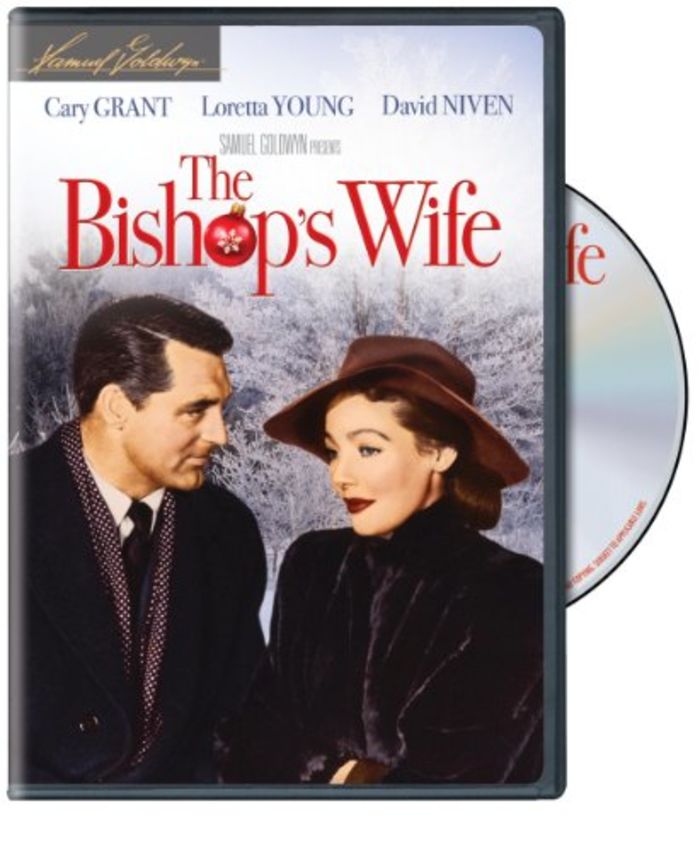
A bishop trying to get a new cathedral built prays for guidance. An angel (Cary Grant) arrives, but his guidance isn’t about fundraising.
Dejected by his efforts to raise money to build a cathedral, Bishop Henry Brougham (David Niven) beseeches heaven for guidance, and is visited immediately by Dudley (Cary Grant), who claims to be an angel. Henry is skeptical, then annoyed when Dudley ingratiates himself into the household as his assistant — and worse, wins the attentions of Henry’s long-suffering and kindly wife (Loretta Young). When Dudley continues to intervene in Henry’s struggles, the bishop decides to challenge heaven.
Certainly communion with angels is traditional at Christmastime, which is the season when most of us mortals need angelic reassurance anyhow. So there is nothing especially surprising about the miracle that occurs in Samuel Goldwyn’s “The Bishop’s Wife,” which opened last night at the Astor—except that it is superb. We cannot recommend you to a more delightful and appropriate Christmas show. – New York Times
While a fantasy, there are no fantastic heavenly manifestations. There’s a humanness about the characters, even the angel, that beguiles full attention. – Variety
Grant’s turn is thoroughly convincing because he himself appears to be having a terrific time: He’s expansive, graceful, and seems always on the verge of chuckling with goodwill. – Entertainment Weekly
Starring Cary Grant, Loretta Young, David Niven, Monty Woolley, James Gleason, Gladys Cooper, Elsa Lanchester, Sara Haden, Karolyn Grimes.
Note: The Bishop’s Wife is set during the Christmas season and has many features associated with Christmas, such as a beautifully-decorated Christmas tree, the Nativity, Santa Claus, angels, snowfall, and gift-giving. The initial scenes of the movie revolve around the Bishop’s wife doing her Christmas shopping, and the final scenes of the film take place on Christmas eve when the Bishop gives his Christmas sermon at St Timothy’s Church. The Bishop’s Wife has become a Christmas favorite to many viewers and, because of that, the movie often pops up on the television during the Christmas season. The film was adapted by Leonardo Bercovici and Robert E. Sherwood from the 1928 novel of the same name by Robert Nathan, and was directed by Henry Koster. In the scene in which Dudley conducts the boys’ choir, the Charles Gounod composition ‘Noël: Montez à Dieu’ (‘O Sing to God’) was performed by the Robert Mitchell Boys Choir. It was remade in 1996 as [The Preacher’s Wife](http://amzn.to/1OG9tXO), which is not a period drama.