
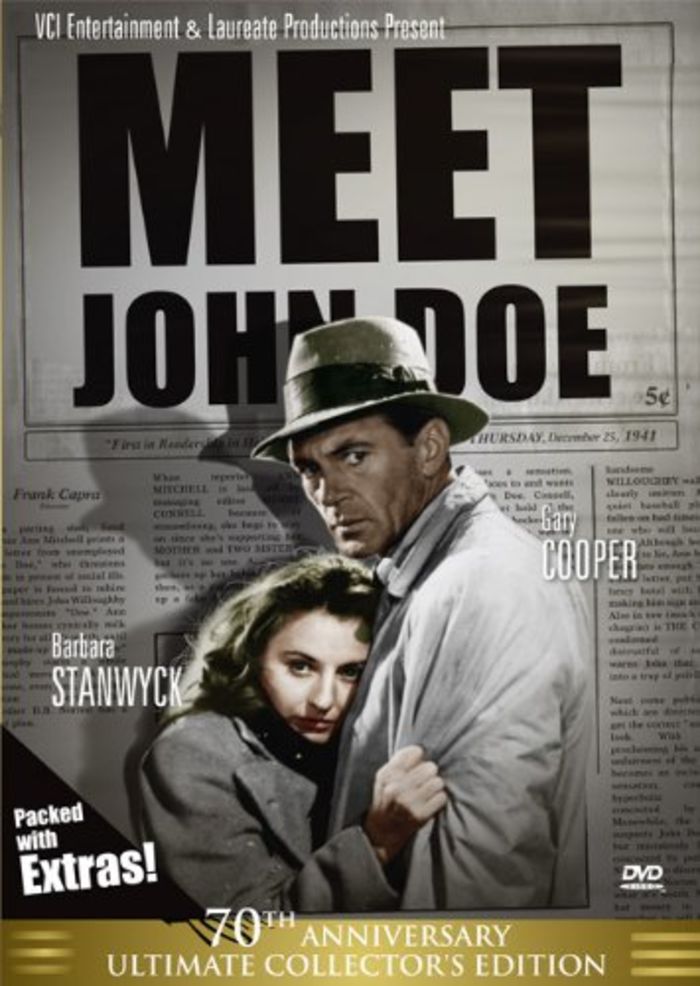
An opportunistic reporter tries saving her career by inventing a story about an anonymous man who wants to commit suicide on Christmas Eve over the state of modern society. With reader fervor growing to know more about John Doe,” she’s forced to produce a real man.
Infuriated at being told to write one final column after being laid off from her newspaper job, Ann Mitchell (Barbara Stanwyck) prints a letter from a fictional unemployed “John Doe” threatening suicide on Christmas Eve in protest of society’s ills. When the letter causes a sensation among readers, and the paper’s competition suspects a fraud and starts to investigate, editor Henry Connell (James Gleason) is persuaded to rehire Mitchell, who schemes to boost the newspaper’s sales by exploiting the fictional John Doe. From a number of derelicts who show up at the paper claiming to have written the original letter, Mitchell and Connell hire John Willoughby (Gary Cooper), a former baseball player and tramp in need of money to repair his injured arm (by Bonesetter Brown), to play the role of John Doe. Mitchell starts to pen a series of articles in Doe’s name, elaborating on the original letter’s ideas of society’s disregard for people in need.
Capra, with his immigrant’s love of the American dream, can easily be criticized as sometimes syrupy but never as simplistic. Here he grapples with no less than updating the tale of the Christ, making a modern day fable (well, as modern as 1941) of one guy sacrificing himself for the greater whole of humanity. Coop is great as the simple man drawn into corruption and seeking redemption. Walter Brennan shines as his friend, a crazy homeless guy and the sanest man in the film, James Gleason is perfect as the common sense common man, and Barbara Stanwyck lights the proceedings as the too smart regular gal, unaware that she needs saving as much as anyone. – Kevin M. Williams
Starring Gary Cooper, Barbara Stanwyck, Edward Arnold, Walter Brennan.
Note: Capra also directed”It’s a Wonderful Life” which also explored the theme of despair and redemption. However, “Though the entire film is based around John Doe’s proposed suicide on Christmas Eve night and despite Stanwyck’s impassioned film-ending speech relating the film’s themes to Christ and the meaning of Christmas, this connection (to Christmas) feels tenuous at best.” – Pop Optiq