

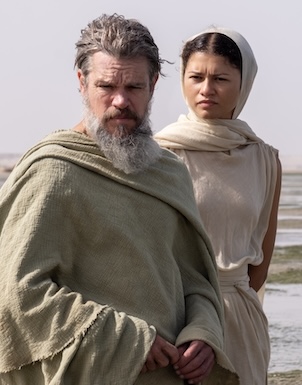
Christopher Nolan’s “The Odyssey” (2026) sits squarely in the mythic action epic genre; just consider the storyline shorthand: After the Trojan War, Odysseus faces a dangerous voyage back to Ithaca, meeting creatures like the Cyclops Polyphemus, Sirens, and Calypso along the way. Still, period drama fans will be drawn to the film’s richly realized historical world.
Through its immersive recreation of the Bronze Age Greek world, meticulous production design, and exploration of family, loyalty, and political conflict, the film exhibits many of the qualities that define the period drama tradition.

To help keep this site running: Willow and Thatch may receive a commission when you click on any of the links on our site and make a purchase after doing so.
The following review of the movie comes from historical fiction author Nancy Bilyeau. Her new novel, The Heiress of Northanger Abbey is a sequel to Jane Austen’s classic. Set in 1820, twenty-two years after the original, it follows Catherine Tilney as she tries to protect her daughter, Phoebe, from the unscrupulous Thorpe family that once threatened Catherine’s happiness. For Austen fans who adore a high-spirited Regency tale, savor a hint of the Gothic—and long to be transported to the mist-shrouded moors.
“The Odyssey” (2026) brings Homer’s foundational saga to IMAX film screens for the first time and opens in theaters everywhere on July 17, 2026.
Expectations for “The Odyssey,” directed by Christopher Nolan, ran so high that it seemed impossible that they could be met. Odysseus himself, played by Matt Damon, tells his wife, “Don’t look for gods in men, you’ll always be disappointed.”
But the fact is, if you are seeking an ancient-world epic film with ambitious themes, emotional stakes, exciting action sequences, and striking visuals, “The Odyssey” will not disappoint. As the first feature film in history to be shot entirely with 70mm IMAX film cameras, it is at its most breathtaking when seen on an IMAX screen. However, its immense narrative pull carries over even on a standard cinema screen.
Nolan has achieved success with superheroes (The Dark Knight Rises), science fiction (Interstellar), and, most recently, historical films set in the 20th century (Dunkirk and Oppenheimer). It may seem at first glance that 2023’s “Oppenheimer,” a biopic of the inventor of the atomic bomb, and “The Odyssey,” a depiction of the legendary 8th-century BC poem by Homer, have little in common. That is not the case. Both films dissect what it costs a man to commit an act he believes will save his people, only to unleash consequences that threaten a civilization.
The basic plot of “The Odyssey”: Odysseus, the cunning king of Ithaca, helps win a 10-year war between Greece and Troy by infiltrating the impregnable city using a hollow wooden horse. Yet following a brutal victory, his long journey home turns into a harrowing struggle against supernatural forces as he repeatedly tries—and fails—to return to his wife and son.

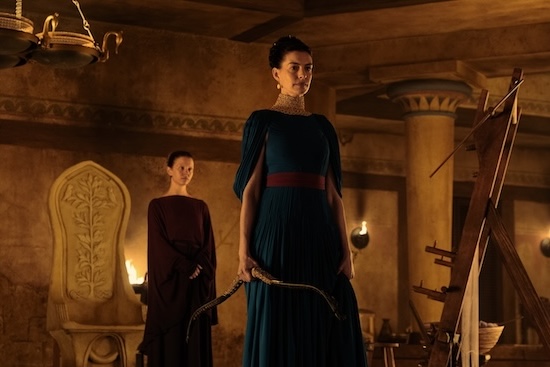
Matt Damon (Saving Private Ryan) brings an intelligence and dry charisma to the “wily” trickster general. When the film opens, Damon looks weathered, with a long white beard, sitting dazed on a beach while being fed lotus blossoms by the beautiful Calypso (Charlize Theron, The Cider House Rules). Concurrently, Odysseus’s strong and resourceful wife, Penelope (Anne Hathaway, Becoming Jane), tries to protect her son, Telemachus (Tom Holland, The Lost City of Z), from dozens of boorish suitors occupying her palace who demand that she acknowledge Odysseus is dead and marry one of them.
Nolan fractures the narrative timeline, jumping between Odysseus preparing Penelope for his absence, the construction of the Trojan horse, the harrowing final battle of Troy, the crew’s trials at sea, and Telemachus’s search for news of his father. Rather than unfolding linearly, this non-chronological structure deepens the psychological weight of the revelations.
“Sword and sandals” epics traditionally take on big themes: conquest, love, revenge, and sacrifice. Where a film like 2004’s Troy focused on the personal sacrifice behind the pursuit of glory, “The Odyssey” reaches further, asking a far more devastating question: Is victory ever worth the catastrophic human cost?
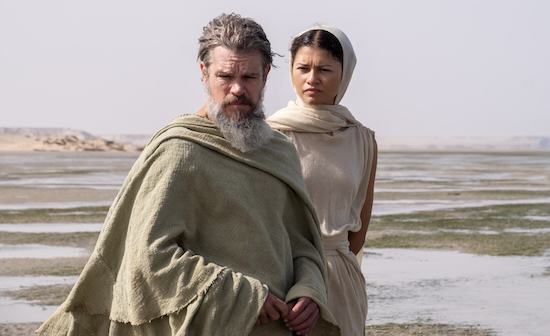
Nolan’s film refuses to sanitize its protagonist, making it clear that Odysseus can be both clever and disastrously reckless. After he blinds a giant cyclops in a flash of anger, his crew’s journey turns from difficult to impossible. About halfway through the film, the very men he is bound to protect stage a mutiny. By the time he washes up alone on Calypso’s beach, Odysseus is so tormented by guilt and shame that he willingly surrenders his memories.
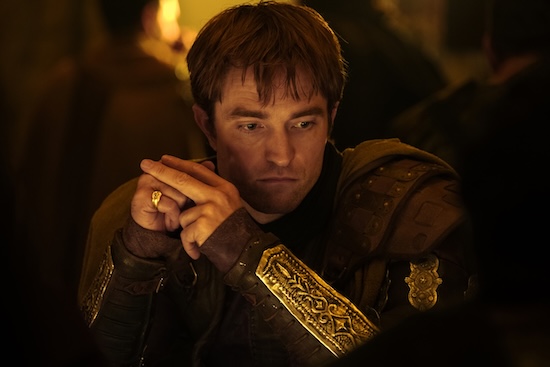
Two of the film’s supporting actors deliver exceptional performances. Just as he did when playing the Dauphin in “The King,” Robert Pattinson—portraying the suitor Antinous—delivers an antagonist so mesmerizing and volatile that he threatens to steal the film.
Samantha Morton (Jane Eyre), playing the sorceress Circe, also brings a fearlessness to her performance, pivoting from warm host to gleefully destructive captor. The scene of her transforming Odysseus’ men into pigs is one of the most talked-about in the film, a miracle of practical special effects using almost no CGI. “I just turned them into what they are!” she shouts defiantly as Odysseus protests.
But Nolan’s greatest achievement lies in the visual power of his set pieces. One standout is Odysseus’ arrival in Hades to ask a prophet how to make his way home. Here, Nolan’s commitment to practical filmmaking reaches its peak. He filmed the sequence on location along the black volcanic beaches of Hjörleifshöfði, Iceland. To create the unsettling visual of the dead rising from the earth, stunt actors were buried under real volcanic sand, breathing through hidden snorkels. Through it all, Nolan creates a haunting nightmare realm that no digital environment could ever replicate, set to a tense musical score created by Ludwig Göransson.
The final third of “The Odyssey” has the fastest pace and the most emotional resonance as Odysseus finally reaches Ithaca. Here, as in Troy, Odysseus is an agent of violence, but the film refuses to glorify the slaughter. To the end, Damon’s protagonist wonders if a person can ever truly be a hero after committing such unheroic acts.
Much of the story takes place in Ithaca, both when Odysseus is missing and after he returns. In those scenes, we are plunged into a complex court with people jostling for power and influence, delivering the same kind of drama to be found in beloved historical series revolving around royal courts, whether it’s that of Henry VIII, Louis the Sun King, or Queen Victoria. Anne Hathaway’s angry outburst over not being allowed to rule her kingdom alone, even though she is completely capable of doing so, is the same kind of lament to be voiced by queens for many centuries afterward. A woman trying to have agency is a story that will always resonate.
“The Odyssey” is not a perfect film. The contemporary, stripped-down dialogue can occasionally sound jarring, and it is a strange creative choice that the Greek gods remain largely off-screen while their monsters and whirlpools wreak havoc on screen.
Yet these flaws pale in comparison to Nolan’s achievement. “The Odyssey” stands as an epic that demands moral questioning, proving that blockbuster cinema can offer artistic gravity.
Nancy Bilyeau is the author of nine historical novels. She wrote the Joanna Stafford trilogy, a trio of thrillers set in Henry VIII’s England, for Simon & Schuster. The first of the books, The Crown, was dubbed “The Page Turner You’ll Tear Through” by Oprah magazine. Her fourth novel, The Blue, was set in the 18th century and drew on her own background as a descendant of the Huguenot settler Pierre Billiou. Her new novel, The Heiress of Northanger Abbey, is a sequel to Jane Austen’s classic. A former staff editor at Rolling Stone and InStyle, Nancy lives with her family in upstate New York.
If you enjoyed this post, see Nancy Bilyeau’s review of “Oppenheimer” (2023).